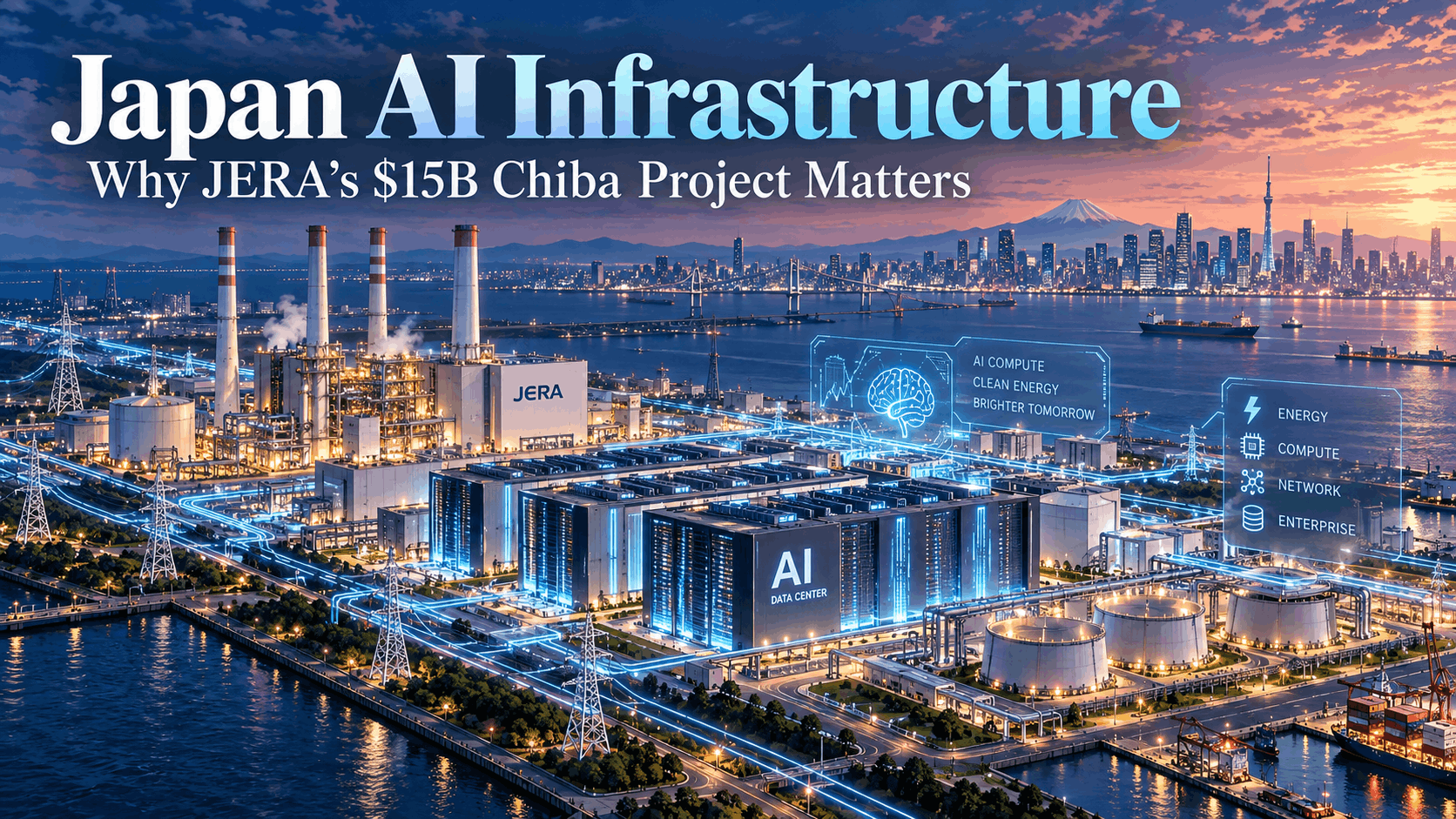
Japan AI Infrastructure: Why JERA’s $15B Chiba Project Matters
Japan AI infrastructure is entering a new phase. On October 1, 2026, JERA, Dell Technologies, and RHAELM announced plans to create a standardized model for large-scale AI infrastructure in Japan, starting at JERA’s Chiba Thermal Power Station.
The first site could provide up to 400 MW of AI computing capacity, while the companies expect total capital deployment to exceed US$15 billion, or roughly ¥2.3 trillion. They aim to begin operations around 2028. JERA says the facility could become Japan’s largest single-site AI infrastructure deployment if the partners develop it at the announced scale.
However, the bigger story is not simply that Japan is building another data center.
Instead, the project reflects a wider shift in the AI race:
AI competitiveness increasingly depends on electricity, cooling, compute, networking, land, and deployment speed as much as it depends on AI models.
Contents
- Why Japan AI Infrastructure Is Becoming Strategic
- What JERA, Dell, and RHAELM Are Building
- Why Power Stations Could Become AI Infrastructure Hubs
- Japan AI Infrastructure and the Watt-Bit Strategy
- What Japan AI Infrastructure Means for Enterprises
- The Challenges Behind Large-Scale AI Infrastructure
- How Renesis Tech Japan Can Support Enterprise AI Adoption
- From AI Models to an AI Industrial Base
Why Japan AI Infrastructure Is Becoming Strategic
For the past several years, much of the AI conversation has focused on models.
Companies competed to build more capable models. Developers pushed reasoning performance forward, while technology providers raced to create increasingly sophisticated AI agents.
Now, however, another constraint is becoming equally important:
Can organizations access enough computing capacity to operate these systems at scale?
Large AI workloads require far more than GPUs. They also need reliable electricity, cooling systems, high-speed networking, storage, data-center capacity, physical land, secure operating environments, and long-term energy supply.
As AI demand grows, these physical constraints can become just as important as improvements in model intelligence.
That is why JERA’s initiative matters.
Rather than treating electricity and computing as separate infrastructure problems, the three companies intend to design them together.
JERA, Dell Technologies, and RHAELM plan to standardize power systems, cooling, facilities, and AI compute. As a result, the partners could reduce engineering complexity and accelerate future deployments.
In other words, Japan AI infrastructure is beginning to look more like an integrated industrial system than a collection of independent data centers.
What JERA, Dell, and RHAELM Are Building
The partners chose JERA’s Chiba Thermal Power Station for their first implementation.
Each company contributes a different capability.
JERA brings the site and large-scale energy infrastructure.
Dell Technologies, meanwhile, contributes rack-scale AI infrastructure through its Dell AI Factory approach.
RHAELM will focus on developing and delivering the AI infrastructure.
In addition, Apollo Global Management could support RHAELM as a strategic investment and financing partner.
The Chiba development could include:
- up to 400 MW of power capacity
- more than US$15 billion in investment
- approximately ¥2.3 trillion in total capital deployment
- operations beginning around 2028
- integrated power, cooling, facilities, and AI compute
- potential expansion to additional JERA locations
Importantly, the partners do not view Chiba as a one-off project.
JERA and RHAELM also intend to explore additional sites during the 2030s. Therefore, Chiba could serve as a template for a much larger domestic AI infrastructure network.
That makes the project strategically more significant.
The partners want to create a repeatable model for Japan AI infrastructure.
Why Power Stations Could Become AI Infrastructure Hubs
One of the most interesting aspects of the project is its location.
Instead of building an independent data center first and then waiting for enough grid capacity, the partners plan to locate the Chiba facility beside an operating JERA power-generation site.
The project could draw behind-the-meter, on-site power from JERA’s generation assets.
This approach addresses a growing problem.
Traditional data-center projects can face long delays because developers must secure grid capacity, electrical connections, permits, and supporting infrastructure. Moreover, AI workloads make those challenges more serious because they consume enormous amounts of electricity.
By placing compute close to an existing generation site, JERA could bring AI infrastructure online faster than developers can through some conventional grid-connected projects.
Consequently, the relationship between the energy sector and the technology sector is changing.
Historically, data centers simply consumed electricity.
In the AI era, access to electricity can influence:
- where companies build computing infrastructure
- how quickly they deploy it
- how much AI capacity they can support
- where AI-intensive industries develop
Therefore, power infrastructure is no longer just an operational concern.
It is becoming part of AI strategy itself.
Japan AI Infrastructure and the Watt-Bit Strategy
The Chiba project also connects with Japan’s broader Watt-Bit Collaboration direction.
The concept is relatively straightforward.
Traditionally, planners often developed electricity networks and telecommunications infrastructure separately. However, rapid growth in AI and data-center demand makes that separation increasingly inefficient.
Under the Watt-Bit approach, Japan aims to coordinate digital infrastructure development with energy availability.
For example, developers can place data centers in locations with suitable power resources while telecommunications providers strengthen the required connectivity at the same time.
JERA has explicitly connected its AI infrastructure model with this broader direction.
As a result, the infrastructure equation begins to change from:
Data Center + Grid Connection
to:
Power + Connectivity + Compute + AI
At first glance, that difference may appear technical.
Strategically, however, it matters.
Countries that coordinate energy, telecommunications, and computing infrastructure effectively could expand AI capacity faster than countries that develop each component independently.
Therefore, Japan AI infrastructure is increasingly becoming a national systems-design challenge rather than only a technology investment.
What Japan AI Infrastructure Means for Enterprises
Most Japanese companies will never build a 400 MW AI data center.
Even so, this development could still affect them.
If Japan AI infrastructure expands significantly, businesses could gain access to a stronger domestic environment for advanced AI deployment.
More Domestic Compute
First, greater domestic computing capacity could make it easier for companies to operate large AI workloads inside Japan.
This could particularly benefit organizations concerned about:
- data sovereignty
- latency
- security
- regulatory requirements
- sensitive business information
As a result, more enterprises could deploy advanced AI without depending entirely on overseas computing infrastructure.
More Private AI
At the same time, companies increasingly want AI systems that work with confidential internal information.
That information may include:
- financial records
- customer information
- intellectual property
- engineering documents
- manufacturing data
- internal knowledge bases
For many enterprises, public AI environments cannot provide the level of control they require.
Therefore, stronger domestic infrastructure could support more private and controlled AI environments.
Larger AI Agents
AI agents create another important consideration.
As agents become more capable, they may operate continuously, interact with several enterprise systems, analyze large information volumes, and perform multi-step workflows.
Consequently, advanced agents can require significantly more computing resources than simple chatbots.
Greater infrastructure availability could therefore support more sophisticated enterprise agentic AI.
Physical AI
The connection with Physical AI is also important.
Robots, computer-vision systems, digital twins, autonomous vehicles, industrial sensors, and AI-enabled factories can generate enormous quantities of data.
Some intelligence will run locally at the edge. However, companies may still need substantial centralized computing capacity for model training, orchestration, analytics, and multimodal workloads.
Therefore, Physical AI and large-scale AI infrastructure are closely connected.
Multimodal AI
Similarly, multimodal systems require substantial computing resources.
Systems that process video, images, voice, documents, and sensor data simultaneously can consume far more capacity than basic text applications.
Consequently, industries such as manufacturing, logistics, healthcare, construction, and mobility could benefit indirectly from greater domestic AI compute availability.
The Challenges Behind Large-Scale AI Infrastructure
However, AI infrastructure at this scale also creates significant energy and environmental challenges.
The Chiba model draws on JERA’s existing power-generation capabilities and LNG value chain. Reliable gas-fired generation could help Japan expand compute capacity quickly, particularly because AI facilities need continuous electricity.
Nevertheless, this creates a strategic tension.
Japan wants to expand AI infrastructure while also pursuing decarbonization and broader GX goals.
Future infrastructure planning will therefore need to balance several priorities:
**Computing growth
- Reliability
- Energy security
- Cost
- Carbon reduction**
The central question is no longer simply:
“How many GPUs can Japan deploy?”
A second question now matters just as much:
“How can Japan power those GPUs reliably, economically, and increasingly sustainably?”
Over time, the answer could involve gas generation, renewable energy, batteries, demand-response technologies, and more flexible data-center operations.
JERA has already shown interest in this direction.
In August, the company invested in U.S.-based Emerald AI, which develops technology designed to coordinate AI data-center workloads with electricity-grid conditions.
This points to an important shift.
Rather than simply producing more electricity, energy providers may increasingly coordinate AI computing demand with available power.
How Renesis Tech Japan Can Support Enterprise AI Adoption
The JERA project highlights an important distinction.
JERA, Dell Technologies, and RHAELM are primarily building the underlying infrastructure layer.
Most businesses do not need to construct that layer themselves.
Instead, they need to decide what useful systems they can build on top of it.
This is where Renesis Tech Japan can support enterprise adoption.
Modern computing infrastructure only creates commercial value when companies connect it to real business processes.
For example, enterprises may need:
- AI agents
- enterprise RAG systems
- private AI applications
- multimodal AI
- computer vision
- workflow automation
- secure data pipelines
- CRM and ERP integration
- internal knowledge systems
- AI dashboards
- API integrations
- cloud and on-premise deployment
For a manufacturer, additional GPU capacity alone creates little value.
However, that infrastructure becomes useful when it powers systems that identify quality defects, predict equipment failures, automate documentation, or support frontline workers.
Likewise, a logistics company gains value when AI improves route optimization, anomaly detection, warehouse automation, or real-time operational intelligence.
Financial institutions can use the same underlying infrastructure to build secure knowledge systems, automate internal workflows, assist employees, and operate controlled AI agents.
Therefore, infrastructure provides the foundation.
Enterprise transformation happens at the application, integration, and workflow layers.
From AI Models to an AI Industrial Base
Japan’s AI strategy is becoming much broader than a competition over foundation models.
The JERA Chiba project demonstrates that the next phase may depend just as heavily on energy companies, data-center developers, infrastructure vendors, telecommunications providers, and investors.
The planned model connects:
Energy → Power Generation → Data Center → AI Compute
From there, enterprises add:
Data → Models → Applications → Business Workflows
Together, these layers form something much larger than an individual AI system.
They begin to create an AI industrial base.
That is why this announcement matters.
Japan AI infrastructure is simultaneously becoming an industrial-policy issue, an energy issue, a data-sovereignty issue, and an enterprise-transformation issue.
Ultimately, the countries that lead the AI era may not simply be those that develop the smartest models.
Leadership may instead depend on the ability to build and connect the entire stack:
Energy → Compute → Data → Models → Applications → Business Workflows
JERA, Dell Technologies, and RHAELM are concentrating primarily on the first layers.