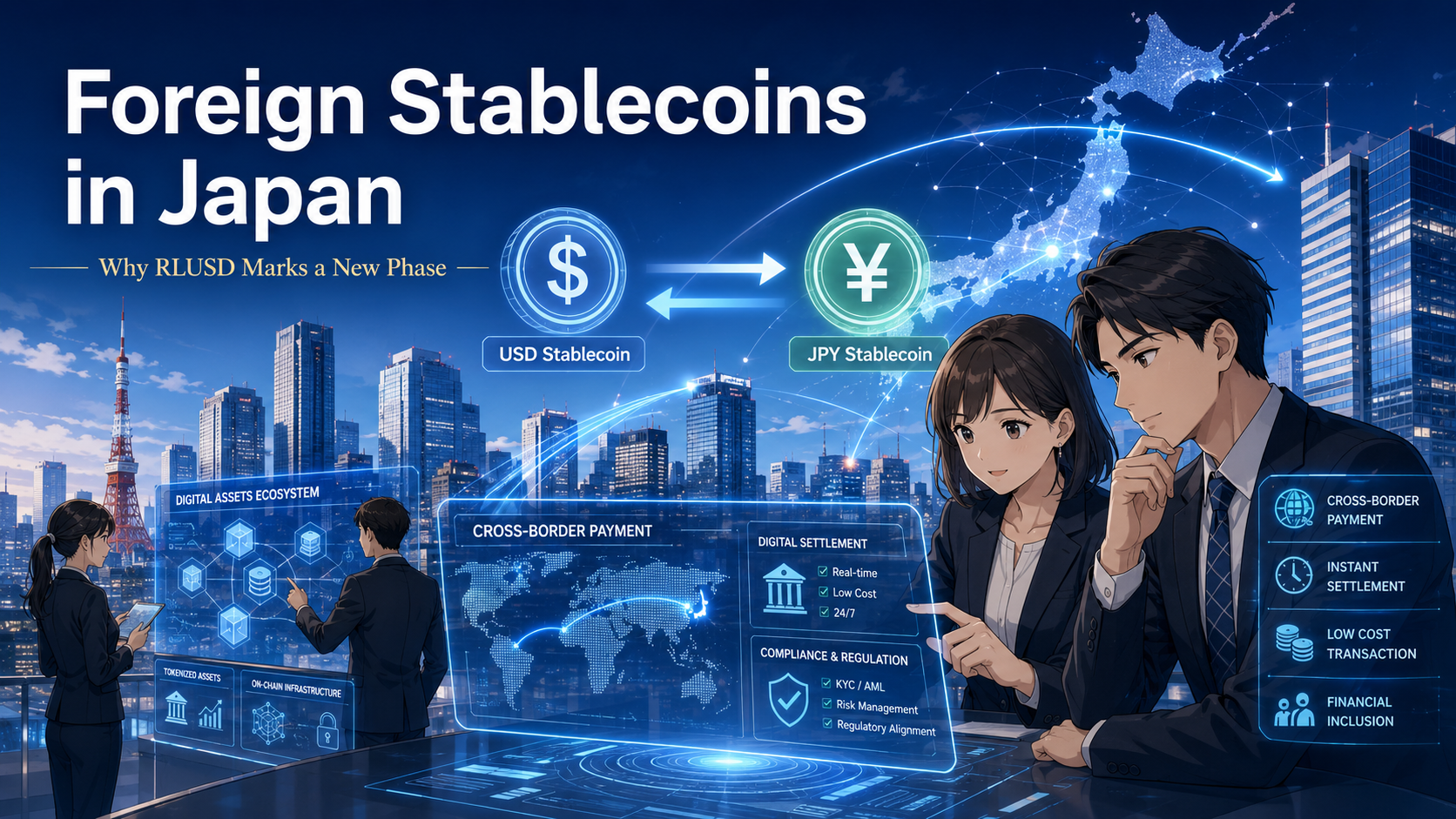
Foreign Stablecoins in Japan: Why RLUSD Marks a New Phase
Foreign stablecoins in Japan are becoming an important part of the country’s digital asset conversation in 2026. Until recently, Japan’s stablecoin market was mostly discussed through yen-based assets such as JPYC and EJPY. But with RLUSD now entering the market through SBI VC Trade, that picture is starting to change.
This development connects with Japan’s wider stablecoin movement, including our earlier articles on EJPY.
What Foreign Stablecoins in Japan Mean for the Market
RLUSD is a U.S. dollar-backed stablecoin. Its availability in Japan gives users and businesses a regulated way to access dollar-based digital settlement through SBI VC Trade.
This should not be seen only as a crypto listing. It may become an important precedent for how foreign stablecoins enter Japan under a regulated framework.
Until now, much of Japan’s stablecoin conversation has focused on yen-based settlement and domestic financial infrastructure. But real business does not stop at national borders. Exporters, SaaS companies, digital content businesses, trading firms, and global treasury teams often need access to dollar-based settlement and liquidity.
RLUSD’s Japan launch sits at that intersection: global stablecoin liquidity meeting Japan’s regulated digital asset market.
How RLUSD Differs from JPYC and EJPY
JPYC and EJPY are yen-based stablecoins. They are closely connected to domestic payment use cases, Japanese business settlement, Web3 payments, and yen-denominated digital financial services.
RLUSD is different because it is linked to the U.S. dollar. That gives it a different role.
It may be especially relevant for:
-
Cross-border payments
-
Payments to overseas partners
-
Digital asset trading
-
Tokenized asset settlement
-
Dollar-based liquidity management
In simple terms, yen stablecoins help digitize domestic settlement in Japan. Dollar-based stablecoins can help Japanese businesses connect to the global blockchain finance network.
The two are not necessarily competing. In many enterprise use cases, they may become complementary.
Why Foreign Stablecoins in Japan Matter for Enterprises
For companies, the real value is not in simply holding stablecoins. The value comes from how stablecoins are integrated into business workflows.
For example, a company may use yen-based stablecoins for domestic payments and dollar-based stablecoins for overseas settlement. A SaaS platform may use stablecoins for usage-based billing. A digital asset company may use them for tokenized asset clearing. A finance team may use AI to reconcile stablecoin transactions against invoices, accounts, and internal records.
But enterprise use requires careful design. A wallet alone is not enough.
Companies need approval rules, KYC processes, transaction monitoring, accounting workflows, audit trails, and integration with ERP or finance systems. This is the difference between personal use and enterprise use.
For businesses, the question is not only:
“Can we send a stablecoin payment?”
The real question is:
“Can we operate stablecoin payments safely, compliantly, and at scale?”
How Foreign Stablecoins Could Change Japan’s Market
The launch of RLUSD shows that Japan’s digital asset market is becoming more international.
Japan has already made progress in regulatory clarity, yen-based stablecoins, digital securities, and on-chain finance. The next phase may combine foreign stablecoins, tokenized assets, digital securities, and AI-driven financial automation.
That creates a new infrastructure challenge for companies. They will need systems that can handle multiple digital assets while meeting requirements for regulation, accounting, audit, and security.
This is where foreign stablecoins in Japan become more than a market headline. They become an enterprise infrastructure question.
How Renesis Tech Japan Supports Stablecoin-Ready Infrastructure
Renesis Tech Japan helps companies build the infrastructure needed to use stablecoins and blockchain payments in real business environments.
For a dollar-based stablecoin like RLUSD, simple wallet connectivity is not enough. Companies need internal approval flows, transaction recordkeeping, audit support, KYC and identity integration, accounting connectivity, and AI-driven reconciliation and monitoring.
Renesis Tech Japan supports smart contract development, wallet architecture, cross-border payment automation, compliance dashboards, on-chain audit trails, and full-cycle development from PoC to production.
RLUSD’s Japan launch is not just another crypto market update. It is a sign that Japan’s stablecoin market is becoming more global, more regulated, and closer to real enterprise use.
The next step is building systems that allow these digital payment tools to be used safely inside business operations.