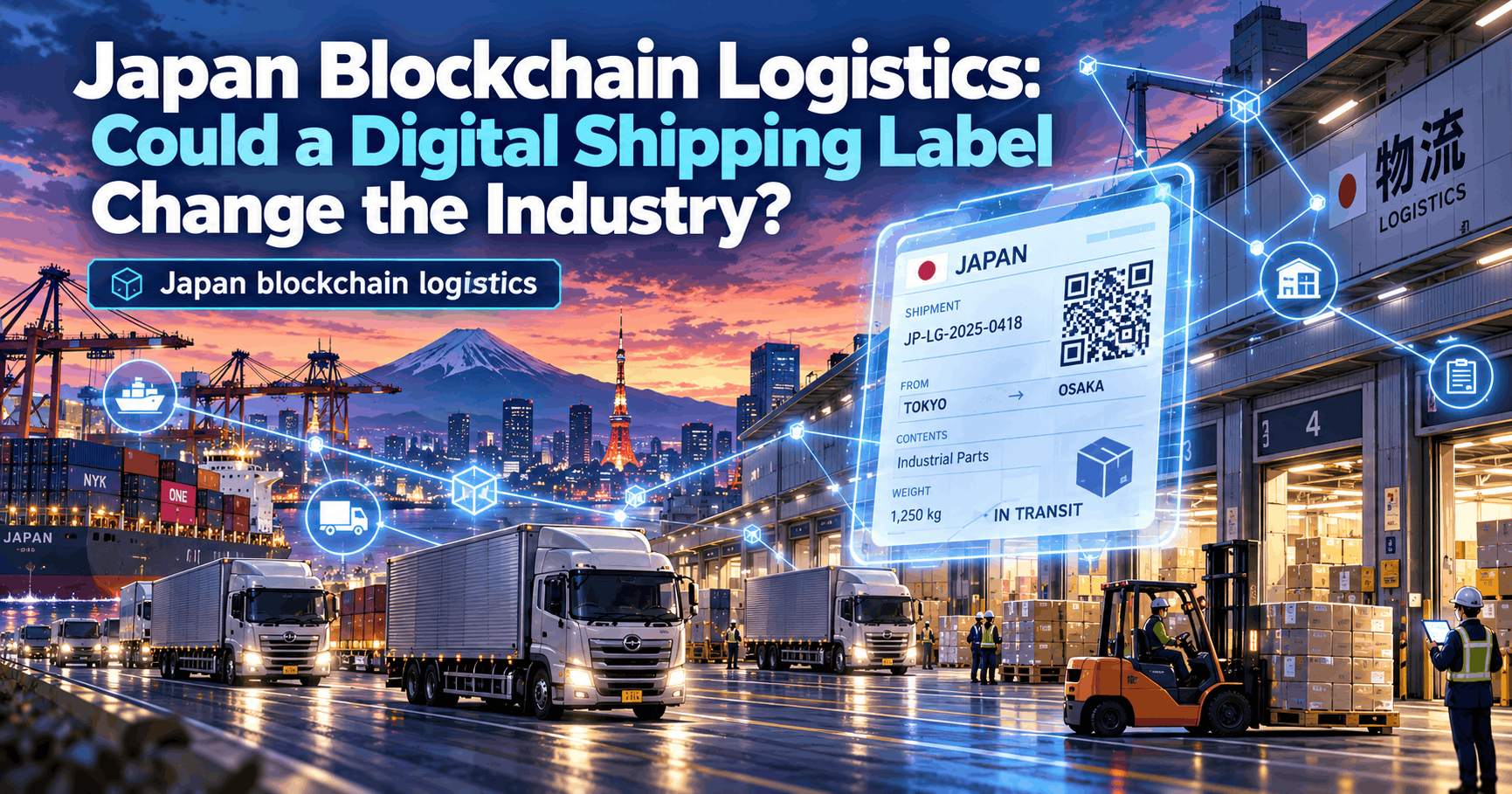
Japan Blockchain Logistics: Bit Waybill
Japan blockchain logistics is entering a new phase, and one of its most interesting developments involves something surprisingly ordinary: a shipping label.
On October 21, 2026, Japanese logistics technology company Logizard officially launched Bit Waybill, a shared digital shipping-label service designed to connect transportation records across different companies.
On the same day, Plat’Home and its subsidiary Things Revolution announced that ThingsToken Protocol, the blockchain infrastructure supporting Bit Waybill, had entered production operation.
Unlike blockchain projects centered on financial assets, Bit Waybill addresses a practical business problem: how can manufacturers, warehouses, carriers, and customers maintain a consistent record of the same shipment when they use different information systems?
It is an important question for Japan.
The country faces persistent transportation capacity constraints, while fragmented information can make cooperation between logistics providers unnecessarily difficult.
For years, digital transformation has focused heavily on improving individual companies’ operations. Warehouses have adopted management software, manufacturers have modernized ERP platforms, and transportation providers have introduced specialized applications.
However, one challenge remains.
What happens when goods leave one company’s system and enter another?
This is where Japan blockchain logistics becomes commercially interesting.
Rather than replacing every existing application, blockchain-supported infrastructure could help independent companies identify shipments, share selected information, and verify transportation records across organizational boundaries.
Bit Waybill offers a timely example of this approach.
Yet its significance should not be exaggerated. The service has formally launched, but industry-wide adoption, measurable efficiency improvements, and long-term commercial outcomes still need to be demonstrated.
The more interesting question is whether an ordinary shipping label can become a building block for a more connected Japanese logistics industry.
Why Japan Blockchain Logistics Is Becoming More Important
Japan’s logistics challenges extend well beyond the shortage of truck drivers.
Labor availability, transportation efficiency, loading practices, delivery requirements, and commercial relationships all influence the sector’s ability to operate sustainably.
Moreover, these problems affect more than transportation companies.
Manufacturers depend on reliable materials delivery. Retailers need predictable replenishment. Warehouses must coordinate incoming and outgoing shipments, while customers increasingly expect accurate delivery information.
When transportation capacity becomes constrained, disruptions can spread throughout the supply chain.
In March 2026, Japan’s Ministry of Land, Infrastructure, Transport and Tourism (MLIT) published updated projections concerning future transportation capacity.
Its assessment suggested that, without additional countermeasures, Japan could face a truck-transport capacity shortfall of approximately 7% in the average-demand scenario and up to 25% in a higher-demand scenario by fiscal 2030.
The government also recognized that measures introduced following Japan’s 2024 logistics challenges had already helped overcome a substantial portion of the previously projected transportation gap.
That distinction matters.
Japan’s logistics situation is serious, but improvement is possible.
The government’s Comprehensive Physical Distribution Policy Outline for fiscal 2026–2030 emphasizes greater logistics efficiency, standardization, digital transformation, cooperation between businesses, and improved working conditions.
Consequently, transportation policy is increasingly concerned with how companies use their existing resources, not simply how many additional vehicles or drivers they can secure.
Better information sharing is one part of that effort.
Consider a shipment moving from a manufacturer to a regional warehouse and then to a retailer.
The manufacturer may identify the goods using an order number. The warehouse may assign a different reference, while the transportation provider uses its own tracking identifier.
Each system may work properly.
Nevertheless, the shipment’s complete history can become difficult to reconstruct across organizational boundaries.
This creates opportunities for manual reconciliation, duplicated records, and delayed communication.
Japan blockchain logistics is relevant because efficient transportation increasingly requires companies to coordinate information beyond their own systems.
Blockchain is not the only possible solution. However, it may offer useful verification capabilities when independent businesses need to rely on shared records.
Bit Waybill: What Actually Launched in October 2026
On October 21, Logizard announced the formal availability of Bit Waybill after introducing the concept earlier in May 2026.
The service is designed around a shared digital shipping identifier, known as the BWB number.
Rather than requiring every participating business to use the same logistics software, Bit Waybill provides a common reference that can connect shipment information across different systems.
The process begins when a BWB number is issued and associated with existing shipping-label data.
Relevant transportation events, including dispatch, handover, and delivery, can then be connected to that number.
Blockchain technology manages evidence associated with the transportation history, while a shared information infrastructure makes the relevant records available to participating systems.
API integration allows companies and application providers to retrieve information needed for their operations.
This approach addresses an important commercial reality.
Japanese logistics businesses already use warehouse-management systems, transportation-management platforms, ERP applications, and specialized operational tools.
Replacing these systems would be expensive and disruptive.
Therefore, the practical opportunity lies in connecting them.
The launch also represents a milestone in Logizard’s collaboration with Plat’Home.
The two companies began joint research into blockchain-supported logistics digital transformation in February 2025.
In May 2026, Plat’Home announced that its ThingsToken technology would provide the foundation for Bit Waybill.
By October, the digital shipping-label service was operating on ThingsToken Protocol’s production infrastructure.
Plat’Home also confirmed that blockchain security company Quantstamp had completed a third-party audit of the smart contracts used by Bit Waybill.
This is a meaningful development for Japan blockchain logistics, particularly because it moves beyond discussing a possible application to offering a production service.
Still, two points require clarification.
First, production launch does not equal nationwide adoption.
Logizard is inviting additional businesses and application providers to participate. The companies have not established that the system is already used throughout Japan’s logistics industry.
Second, a completed smart-contract audit does not guarantee the security of every connected application.
APIs, access permissions, business processes, user accounts, and data-entry controls remain important.
The announcement confirms that the service is available and its underlying blockchain infrastructure is operating.
Its broader impact will depend on what happens next.
Imagine a manufacturer in Japan that ships finished components through two independent logistics providers.
The first company collects the goods from the factory and transports them to a distribution center.
A second company handles delivery to the customer.
Each organization operates its own systems.
The manufacturer can see that its goods were dispatched. The first carrier records collection and handover, while the second carrier records final delivery.
However, those records may not share a common identifier.
If a discrepancy occurs, employees may need to compare several databases, emails, or shipment documents to establish what happened.
A shared digital shipping label could simplify that process.
Step 1: Assign a common shipment identifier
Bit Waybill issues a BWB number that links to existing shipping-label information.
The identifier provides a consistent reference for participating organizations.
Step 2: Associate transportation events with the identifier
Dispatch, handover, delivery, and other relevant events can be recorded against the BWB number.
As a result, different systems can refer to the same shipment without relying entirely on their internal identifiers.
Step 3: Preserve verifiable evidence
Blockchain technology supports verification of the recorded transportation history.
The objective is to make unauthorized changes easier to detect and reduce dependence on records controlled by only one participant.
Step 4: Connect existing business applications
Through APIs, authorized systems can obtain the transportation information they need.
For example, a warehouse-management application could access relevant shipment information without requiring the carrier to operate the warehouse’s internal software.
The underlying ThingsToken Protocol uses Ethereum and its Layer 2 ecosystem.
According to Plat’Home, its architecture incorporates ERC-3525 for associating digital identity and rights information with physical objects, alongside ERC-6551 token-bound accounts for managing information connected to those objects.
These technologies provide a way to associate digital records with identifiable physical items.
However, businesses should focus on what the architecture enables rather than the technical standards themselves.
For Japan blockchain logistics, the commercially important question is whether these shared identifiers and records make everyday coordination easier.
Can employees identify the same shipment across companies?
Can they verify when a handover was recorded?
Can they resolve missing information without repeatedly contacting several departments?
If the answer becomes yes, then the technology may deliver practical value.
That value must still be established through real operational measurements.
Does Every Digital Shipping Label Need Blockchain?
Bit Waybill raises a broader question that businesses should examine carefully.
Why use blockchain when conventional databases, shared APIs, and digital signatures already exist?
A common shipment identifier does not inherently require blockchain.
Companies can create standardized reference numbers through centralized platforms.
Likewise, they can exchange information using conventional software integration.
For many business relationships, those technologies may be entirely sufficient.
The potential advantage of blockchain appears when independent parties require verifiable records and do not want to depend exclusively on the database controlled by one organization.
Consider a transportation dispute.
A manufacturer believes a carrier received its shipment at a particular time.
The carrier’s internal records show something different.
A shared record that participating organizations can independently verify might help establish which transportation events were registered and when.
However, blockchain does not automatically establish the truth of the physical event.
If an employee records a handover that never occurred, preserving the record does not make it accurate.
Reliable evidence still depends on trustworthy data collection, suitable verification procedures, and appropriate access controls.
There are also costs and trade-offs.
Companies must consider network fees, integration requirements, governance, privacy, system performance, and maintenance responsibilities.
Furthermore, a decentralized technical architecture does not eliminate the need for organizational agreements.
Participants must decide who can write information, who can access it, and how incorrect records will be handled.
Therefore, the strongest argument for blockchain is not that it is newer than conventional technology.
It is that independent verification may create additional value in specific multi-party workflows.
For Japan blockchain logistics to become commercially sustainable, businesses will need to demonstrate that this additional value outweighs the complexity involved.
What Japan Blockchain Logistics Could Improve for Businesses
Logizard identifies several intended applications for Bit Waybill, including joint transportation, relay transportation, unified shipment management, and delivery-information sharing.
These are particularly relevant because Japan’s transportation challenges cannot be solved through isolated improvements alone.
Joint transportation
Manufacturers and distributors sometimes operate separate transportation networks along overlapping routes.
Shared information could make it easier to explore opportunities for coordinated shipments and more efficient vehicle utilization.
However, the ability to exchange data does not automatically produce viable joint transportation arrangements.
Businesses must still agree on schedules, pricing, cargo compatibility, responsibilities, and liability.
Relay transportation
Long-distance transportation may require several carriers or drivers to handle the same shipment.
A consistent digital reference could support coordination between participants and help maintain a clearer record of handovers.
Nevertheless, successful relay transportation also depends on suitable facilities, route planning, driver availability, and operating procedures.
Manufacturing distribution
Manufacturers frequently ship products through different warehouses, transportation providers, and distribution channels.
These arrangements can create fragmented shipment records.
A shared identifier could help connect information from factory dispatch through later stages of distribution.
The value would be particularly relevant when manufacturers need visibility across several independent service providers.
Retail and wholesale operations
Retailers may receive deliveries from numerous suppliers and carriers.
When information formats differ, staff can spend considerable time reconciling records.
More consistent shipment identifiers could support delivery confirmation, exception handling, and information sharing.
However, the benefits depend on participation and integration quality.
Cold-chain logistics
Plat’Home has also identified temperature-controlled logistics as a possible future expansion area for ThingsToken Protocol.
In principle, verifiable digital records could help organizations review selected information about temperature-sensitive shipments.
Yet blockchain cannot determine whether refrigeration equipment functioned correctly unless reliable sensor data and appropriate verification controls are available.
These scenarios show why Japan blockchain logistics could become relevant to businesses beyond specialist blockchain companies.
The larger opportunity is interoperability.
Instead of requiring every company to operate identical software, shared infrastructure could allow different applications to exchange agreed information.
The limitation is equally important.
Better records can support better transportation decisions, but they do not replace the vehicles, workers, facilities, or business agreements required to move goods.
The Physical Internet and Japan’s Logistics Policy Shift
The Bit Waybill announcement explicitly connects the service with the longer-term vision of the Physical Internet.
The concept refers to logistics networks that can exchange and move goods more efficiently through standardized and interoperable systems.
Today, much of the digital world operates through protocols that allow independent networks to communicate.
A similar principle could influence physical logistics.
Instead of each organization optimizing transportation only within its own network, participating businesses could cooperate across a broader infrastructure.
Such cooperation might involve shared transportation capacity, standardized cargo information, interoperable systems, and coordinated handovers.
However, moving physical goods is more complicated than transferring digital information.
Packages occupy space. Vehicles follow physical routes. Warehouses operate within capacity constraints, while shipments must satisfy handling, safety, timing, and contractual requirements.
Therefore, a Physical Internet requires more than a shared information system.
It depends on operational standardization and cooperation between organizations.
Japan’s 2026–2030 logistics policy reflects this broader direction.
The government has prioritized efficiency improvements, changes to commercial practices, digital transformation, logistics standardization, and stronger collaboration between participating businesses.
In this context, Bit Waybill offers one possible component of a more interoperable logistics environment.
It does not establish that Japan has already achieved a functioning nationwide Physical Internet.
Rather, the service explores how common shipment identifiers and shared records could help connect participating companies.
For Japan blockchain logistics, this represents an important distinction.
The long-term opportunity is not simply putting transportation records on a blockchain.
It is helping independent systems work together more effectively.
What Could Stop Japan Blockchain Logistics From Scaling?
A service can be technically operational without becoming commercially widespread.
Bit Waybill’s next challenge is therefore likely to involve adoption, integration, and governance.
Several issues deserve attention.
Participation and network effects
Shared shipment information becomes more useful when enough organizations participate.
A manufacturer may see limited benefits if its transportation partners cannot use the common identifier.
Similarly, carriers may hesitate to invest in integration unless major customers or partner networks support the approach.
This creates a coordination challenge.
Data standardization
Using the same shipment ID does not guarantee that companies interpret transportation events consistently.
One organization might record delivery when goods reach a distribution center.
Another might record delivery only when the final recipient accepts them.
Unless those definitions are standardized, shared records may still produce confusion.
Trustworthy data entry
A blockchain can help detect certain changes to registered evidence.
It cannot guarantee that every registered event accurately reflects reality.
Businesses must therefore establish reliable procedures for creating, confirming, and correcting transportation records.
Privacy and commercial sensitivity
Shipment information may reveal customers, delivery routes, business volumes, or commercial relationships.
Companies need clear rules governing which participants can access particular information.
Independent verification should not mean unrestricted exposure of confidential business data.
Integration with existing software
Many Japanese SMEs depend on specialized systems, spreadsheets, or manual operating procedures.
Integration must fit the software and workflows those businesses already use.
Otherwise, a shared information platform may introduce additional work rather than reduce it.
Commercial incentives
Different participants may benefit in different ways.
A manufacturer may prioritize visibility, while a carrier focuses on administrative efficiency.
A warehouse operator may care most about accurate handover records.
Successful adoption requires a convincing value proposition for each participant.
These challenges suggest that Japan blockchain logistics will advance through practical cooperation as much as through technical innovation.
A reliable blockchain is important.
But so are clear business rules, shared data definitions, suitable interfaces, and measurable operational improvements.
A Practical Roadmap for Japanese SMEs
For smaller logistics companies, manufacturers, and warehouse operators, the first objective should not be adopting blockchain.
It should be identifying where disconnected information causes unnecessary work.
A sensible starting point is to examine one shipment journey.
For example, a manufacturer could follow goods from factory dispatch through warehouse handling and final carrier delivery.
At each stage, the business should identify how shipment information is recorded and transferred.
Begin with the existing workflow
Which systems are involved?
Where are shipment identifiers changed or duplicated?
How often do employees need to contact other organizations to confirm transportation information?
These questions can reveal the operational problem before any technology is selected.
Measure the friction
Businesses can evaluate the number of shipment-record mismatches, time spent reconciling information, delivery-confirmation delays, and administrative effort required to resolve exceptions.
A baseline makes later improvements easier to assess.
Identify the minimum information participants need to share
Not every organization needs access to the entire transportation history.
Companies should define the relevant shipment identifiers, events, permissions, and verification requirements.
Evaluate conventional integration first
Some problems can be solved using APIs, better database integration, standardized identifiers, or improved workflow design.
There is little value in introducing blockchain if simpler systems can meet the requirement reliably.
Introduce verification where it adds value
When independent organizations need shared evidence that should not depend entirely on one participant’s records, blockchain may become worth evaluating.
This decision should follow an assessment of governance, costs, data privacy, and integration requirements.
Run a controlled pilot
A practical project might involve one manufacturer, one warehouse, and one transportation provider.
The participants could evaluate whether common identifiers reduce reconciliation time or improve the completeness of recorded handovers.
The results should determine whether wider deployment is justified.
For Japanese SMEs, the most promising approach to Japan blockchain logistics is incremental.
Start with a business problem.
Improve the information flow.
Then introduce technologies that provide demonstrable additional value.
How Renesis Tech Japan Can Support Logistics DX
The commercial challenge for Japanese businesses is often not the absence of technology.
It is the difficulty of connecting technology with existing operations.
A manufacturer may already have an ERP system. A warehouse may use a dedicated WMS, while a transportation provider maintains its own dispatch and delivery applications.
These systems may perform their individual functions effectively.
Yet information can become fragmented when goods move between organizations.
Renesis Tech Japan focuses on custom software development, enterprise AI, workflow automation, system integration, and blockchain solutions.
These capabilities are relevant to logistics businesses seeking to improve coordination without unnecessarily replacing their existing platforms.
Connecting existing logistics systems
Custom APIs and integration services can support information exchange between warehouse-management systems, ERP applications, transportation platforms, and operational dashboards.
The objective is to reduce duplicated work and establish more consistent information flows.
Building shipment visibility tools
A tailored application could consolidate authorized shipment information from participating systems.
For example, a manufacturer might use a single interface to review relevant dispatch records, transportation statuses, and exceptions across several partners.
The scope would depend on available integrations and access permissions.
Evaluating blockchain verification
Where independent verification is necessary, businesses can assess blockchain-based recordkeeping alongside centralized alternatives.
Potential applications include shared shipment-event evidence, digital credentials, and verifiable records used between organizations.
However, no blockchain implementation should be recommended before its commercial and operational justification is established.
Applying enterprise AI selectively
AI can also support logistics information workflows.
For example, an AI assistant could help employees compare shipment records, summarize exceptions, or prepare reports from authorized internal data.
Human review and appropriate information controls would remain important, particularly when outputs influence operational decisions.
AI and blockchain do not need to be deployed together.
Each should solve a specific problem.
Starting with a focused implementation
For businesses exploring Japan blockchain logistics, a practical first engagement could involve mapping one cross-company shipment workflow.
That assessment would establish where information becomes disconnected and which systems need to communicate.
From there, a company could evaluate whether API integration, workflow automation, shared identifiers, blockchain verification, or a combination of these approaches is appropriate.
A limited implementation could then be assessed against measurable operational indicators.
This is the approach Renesis Tech Japan advocates: practical system improvements, implemented around real business requirements.
The goal is not to introduce additional technology for its own sake.
It is to help Japanese businesses connect systems, reduce information fragmentation, and build more reliable operational processes.
Learn more: https://www.renesistech.jp/
The Real Test for Japan Blockchain Logistics
The October 21 launch of Bit Waybill is a noteworthy development because it brings blockchain into an operational area that rarely receives the same attention as financial technology.
Logizard has formally introduced a shared digital shipping-label service.
Plat’Home and Things Revolution have brought ThingsToken Protocol into production operation, supporting the service’s digital records and verification infrastructure.
Together, these developments provide a concrete example of blockchain being applied to the movement of physical goods.
However, the launch is a starting point, not a proven transformation of Japan’s logistics industry.
The wider results will depend on whether businesses adopt shared identifiers, integrate their existing applications, agree on data standards, and experience measurable improvements in their operations.
That is the real test.
Japan’s logistics constraints cannot be eliminated through information technology alone.
Driver availability, working conditions, transportation capacity, commercial incentives, and physical infrastructure will continue to matter.
Nevertheless, disconnected information can make an already difficult environment harder to manage.
When companies struggle to identify the same shipment across different systems, cooperation becomes more complicated.
When transportation events require manual reconciliation, administrative effort increases.
And when records cannot be independently verified, disagreements may take longer to resolve.
Japan blockchain logistics offers a possible way to address selected parts of this problem, particularly where several independent organizations need a common reference and verifiable transportation records.
Its success should not be judged by the number of tokens created or the volume of information recorded on a blockchain.
Instead, businesses should ask more practical questions.
Are shipments easier to identify across companies?
Can handovers be confirmed more reliably?
Have reconciliation delays decreased?
Do employees spend less time resolving fragmented information?
Can the participating organizations cooperate more effectively without abandoning their existing systems?
If measurable improvements follow, blockchain-supported logistics infrastructure will have demonstrated its value.
If they do not, the technology will need to be reconsidered.
Ultimately, the most important innovation may not be the blockchain itself.
It may be the willingness of different businesses to treat transportation information as something they can coordinate across organizational boundaries.
The future of Japan blockchain logistics may begin with a digital shipping label, but its long-term value will depend on whether that label helps companies build a more connected, efficient, and trustworthy logistics network.
Editorial disclosure
This article presents an evidence-based industry analysis as of October 27, 2026. Bit Waybill’s formal launch, ThingsToken Protocol’s production operation, and the completion of the specified smart-contract security audit are confirmed announcements. Potential improvements in transportation efficiency, nationwide adoption, and commercial returns remain prospective and should not be interpreted as verified outcomes.
Primary References
- Logizard, October 21, 2026: Official launch of Bit Waybill
- Plat’Home, October 21, 2026: ThingsToken Protocol begins production operation
- Bit Waybill official service website
- MLIT, March 2026: Logistics policy recommendations toward fiscal 2030
- MLIT: Fiscal 2030 transport-capacity projection
- MLIT, March 31, 2026: Comprehensive Physical Distribution Policy Outline, FY2026–FY2030