






Japan Blockchain Startup Guide 2026: Funding, JETRO & Growth
Japan Blockchain Startup Guide 2026: How to Secure Funding and Scale
Introduction
Building a Japan blockchain startup in 2026 requires more than just a whitepaper; it requires navigating a sophisticated support network of JETRO-linked programs, Web3 Salon, and corporate-backed initiatives. For founders, this ecosystem offers a unique “four-pillar” advantage: capital, mentorship, strategic investor access, and a clear path to international expansion.
The 4-Layer Support Network
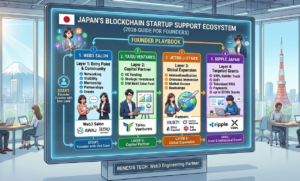
If you are a founder, visualize the ecosystem in these four distinct layers:
-
Web3 Salon: The primary entry point for networking and visibility. Visit Web3 Salon.
-
Taisu Ventures: The leading capital partner, offering a specific $1M fund for startups entering through the Web3 Salon route. Apply via Taisu Ventures.
-
JETRO (J-StarX): The internationalization engine. Their program connects Japanese founders with global hubs like Hub71 and Outlier Ventures. Explore JETRO J-StarX.
-
Ripple Japan Program: A targeted lane for those building on XRPL, providing grants up to $200,000 for DeFi and RWA projects. Learn about Ripple Grants.
The Japan Blockchain Startup Playbook
Step 1: Define Your Compliance Category
Do not apply as a “general Web3 project.” Position your Japan blockchain startup within established categories: Payments, DeFi, Tokenized Real-World Assets (RWA), or Compliance Tooling.
Step 2: Leverage the Web3 Salon Discovery Layer
Start here to build local credibility. Use the salon to map your route before pitching to VCs.
Step 3: Access Strategic Funding Lanes
Submit your application through the Web3 Salon x Taisu Ventures form if you need growth-stage capital. If your infrastructure is built on XRPL, prioritize the Ripple lane.
Step 4: Build for Institutional Infrastructure
In 2026, the trend has shifted toward financial infrastructure and enterprise-ready products. Your pitch deck must demonstrate regulatory awareness and explain how your product fits into Japan’s banking or payments stack.
Common Pitfalls for Founders
Many founders fail in the Japanese market because they:
-
Pitch “Web3” as a concept rather than a specific utility like remittance or treasury tooling.
-
Request funding before establishing a local pilot or “Proof of Concept” (PoC).
-
Lack a clear posture on Japanese compliance and the Financial Instruments and Exchange Act.
Professional Infrastructure Support
Launching a successful Japan blockchain startup often requires specialized technical architecture that meets institutional standards.
At Renesis Tech, we help organizations design and ship “compliance-first” blockchain products. From stablecoin issuance and RWA tokenization to building secure disaster-prevention digital infrastructure, our team provides the engineering depth needed to scale.
Our Core Services:
-
Institutional Strategy: Shaping products for megabanks and enterprise partners.
-
Full-Cycle Engineering: Development of wallets, payment rails, and settlement platforms.
-
PoC Development: Rapid prototyping for regulators and strategic investors.
Ready to build the future of Japanese finance? CONTACT US to schedule a consultation on your next project.