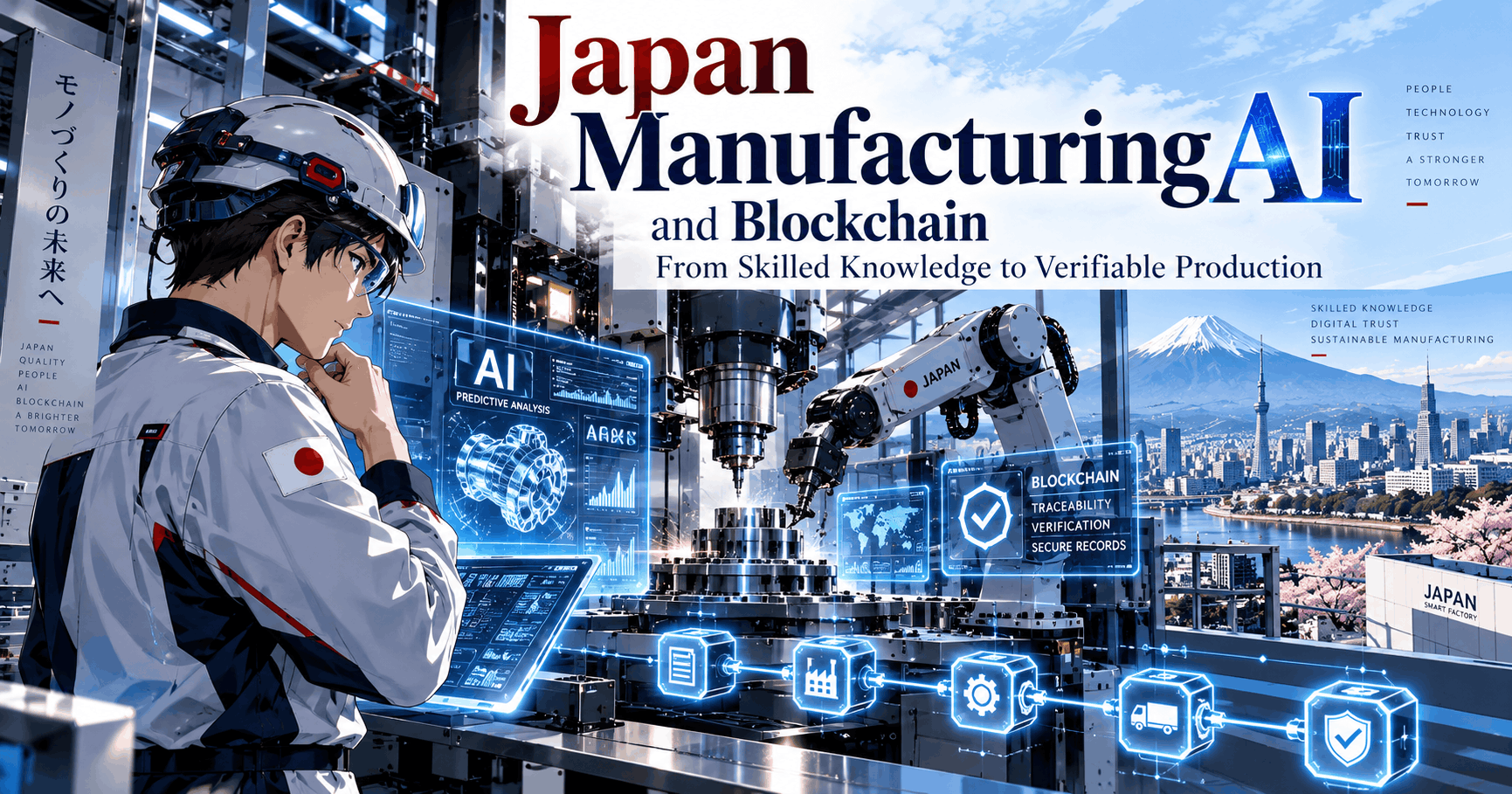
Japan Manufacturing AI: Skills and Blockchain
Japan Manufacturing AI and Blockchain: From Skilled Knowledge to Verifiable Production
Japan manufacturing AI is entering a new phase. Artificial intelligence is moving beyond repetitive factory automation toward a more difficult challenge: understanding how experienced workers make decisions, preserving their expertise, and helping manufacturers apply that knowledge consistently.
At the same time, blockchain is finding a different role in Japanese industry. Rather than focusing exclusively on digital assets and financial transactions, companies are exploring how the technology can support product traceability, environmental reporting, and the verification of information shared across supply chains.
Recent developments illustrate both shifts.
On October 16, 2026, Japanese AI company ABEJA announced a collaboration with machine-tool manufacturer Yamazaki Mazak to develop AI agents for machining process planning, production scheduling, and robotic learning.
Meanwhile, Panasonic Holdings and AQTIA are working to expand Tracephere, a blockchain-based platform designed to support industrial traceability and circular-economy applications.
Fujitsu has also been examining how blockchain and data-sharing technologies could support the verification of environmental value associated with lower-emission steel.
These are independent initiatives, not parts of a single industrial platform. Nevertheless, they point toward two increasingly important requirements in Japanese manufacturing.
Factories need to preserve the knowledge behind production decisions. Their customers and business partners need reliable evidence of what happened during production.
Japan manufacturing AI could help address the first challenge. Blockchain-based verification systems could support the second, particularly where multiple organizations need to trust shared records.
The opportunity is not simply to combine two emerging technologies.
It is to make industrial knowledge more reusable, production information more reliable, and manufacturing relationships easier to verify.
Why Japan Manufacturing AI Is Moving Beyond Automation
Japan has spent decades developing sophisticated manufacturing technologies.
Its industrial strengths include precision machinery, robotics, advanced materials, machine tools, and highly standardized production systems.
These capabilities have helped Japanese manufacturers maintain consistent quality across automotive, electronics, industrial equipment, and other sectors.
However, even highly automated factories continue to depend on human judgment.
A CNC machine can execute a programmed operation with remarkable precision. Choosing the right machining process, however, often requires years of practical experience.
An engineer must consider material properties, tool wear, dimensional tolerances, cutting conditions, equipment capabilities, and production requirements.
Similarly, a production manager must account for machine availability, inventory levels, urgent customer orders, maintenance activities, and delivery commitments.
These decisions do not always follow simple rules.
An experienced technician may recognize an unusual machine sound before a sensor triggers an alarm. Another may know that a technically acceptable cutting process could cause quality problems under particular conditions.
Such decisions reflect knowledge developed through repeated experience.
This is why Japan manufacturing AI is becoming more interesting than conventional factory automation.
Traditional automation generally performs activities according to predefined instructions and operating limits.
Newer AI systems aim to interpret changing conditions, evaluate alternatives, and support decisions that previously required specialist judgment.
The difference is significant.
Instead of merely repeating a programmed task, AI could help determine which task should be performed, how it should be scheduled, and when operating conditions require adjustment.
Nevertheless, greater flexibility introduces new risks.
In manufacturing, an incorrect recommendation can damage machinery, waste expensive materials, interrupt production, or compromise worker safety.
Therefore, the value of Japan manufacturing AI should not be measured solely by model sophistication.
Its real value depends on whether it can help people make better decisions under actual production conditions.
The Skilled Knowledge Japan Manufacturing AI Must Preserve
Japan’s manufacturing sector faces a long-term challenge involving workforce development and the transfer of specialized expertise.
The country’s 2026 Manufacturing White Paper highlights the importance of skills succession, particularly as businesses manage an aging workforce and recruitment difficulties.
According to the report, 54.8% of surveyed manufacturing businesses identified re-employment or extended employment of older workers as a measure for transferring skills.
This was the most commonly reported approach to skills succession.
The finding illustrates how strongly many manufacturers continue to depend on experienced employees.
Keeping skilled workers employed longer can support knowledge transfer. However, it does not necessarily solve the underlying problem.
Consider a precision-machining company employing a technician with three decades of experience.
That employee may understand which cutting conditions work best for particular materials, which machine configurations frequently create problems, and how to respond when equipment behaves unexpectedly.
Some of this information appears in manuals, maintenance reports, or production records.
Other knowledge exists primarily in the technician’s experience.
When the employee retires, the company may retain its machinery, technical documentation, and historical records.
Yet it can still lose the reasoning that connects those resources.
The same challenge affects production planning.
An experienced manager might know that a particular supplier regularly experiences delays during certain periods. That knowledge could influence scheduling decisions without ever appearing in a formal database.
A replacement employee may need considerable time to develop comparable judgment.
The challenge is not simply storing what experienced workers know. It is preserving enough context for other people to understand when and why that knowledge matters.
This creates an important opportunity for Japan manufacturing AI.
Enterprise knowledge systems can organize technical manuals, maintenance histories, troubleshooting records, production decisions, and explanations from experienced employees.
AI-assisted retrieval can then help workers locate relevant information and compare previous cases.
However, uploading documents into an AI chatbot does not automatically capture human expertise.
Manufacturers also need to preserve the reasoning behind decisions.
Imagine an engineer selecting a slower machining process even though a faster option appears technically feasible.
A basic analytical system might interpret the decision as inefficient.
However, the engineer may have chosen the slower process because the faster alternative previously caused excessive vibration, premature tool wear, or unacceptable surface variation.
Without that context, AI could recommend the wrong approach.
Consequently, companies should document important operating conditions, alternative approaches, reasons for decisions, known failure patterns, and eventual outcomes.
These details can make historical information more useful.
Yet human involvement remains essential.
Experienced engineers must help evaluate whether AI-generated recommendations are technically appropriate and safe.
The purpose of Japan manufacturing AI should not be to turn past decisions into unquestionable rules.
It should be to make valuable expertise easier to retrieve, examine, challenge, and improve.
What ABEJA and Yamazaki Mazak Are Developing
The October 16 collaboration between ABEJA and Yamazaki Mazak provides a timely example of how industrial AI is evolving.
The companies announced plans to jointly develop AI capabilities for manufacturing environments.
ABEJA contributes its AI development expertise and platform technologies. Yamazaki Mazak contributes its experience in machine tools, machining processes, and industrial automation.
The announced collaboration covers three areas.
AI agents for machining process planning
The companies intend to develop an AI agent capable of proposing machining methods, processing sequences, and cutting conditions for particular components.
These decisions normally require specialist knowledge.
Choosing an appropriate machining process involves balancing precision, operating time, material characteristics, tool limitations, and production costs.
An AI agent could potentially help engineers evaluate alternatives and prepare process plans more efficiently.
If the system performs reliably, it may also reduce dependence on a small number of experienced specialists for certain planning activities.
However, these capabilities remain under development. The announcement does not establish commercially verified performance across customer factories.
AI agents for production scheduling
The second initiative focuses on production planning.
The proposed agent would consider production requirements, equipment operating conditions, material inventory, and practical factory knowledge.
A manufacturer handling multiple product variations may need to revise schedules frequently.
An urgent customer order, unexpected maintenance requirement, or material shortage can disrupt an otherwise efficient production plan.
AI could help identify feasible alternatives and prepare revised schedules.
Nevertheless, its recommendations would depend on accurate information about inventory, machine availability, delivery requirements, and operational restrictions.
Without reliable data, even a sophisticated AI model could produce impractical plans.
Robot-learning infrastructure
The third initiative involves an environment for collecting manufacturing data, training AI models, evaluating their performance, and testing robotic actions on physical equipment.
The companies plan to use ABEJA Platform and human-in-the-loop approaches to support development.
This direction is particularly interesting because it connects intelligent decision-making with physical manufacturing operations.
However, the closer AI gets to controlling machinery, the greater the importance of technical validation and safety controls.
A system that retrieves maintenance instructions requires a different level of validation from one that changes machine operating parameters.
For that reason, Japan manufacturing AI cannot be evaluated in the same way as ordinary office automation.
Its effectiveness must be demonstrated against real manufacturing constraints.
The ABEJA–Mazak partnership represents a meaningful step toward this ambition, but it should not yet be treated as proof of fully autonomous, commercially mature factories.
The more important development is the problem the companies are attempting to solve.
How can manufacturers make specialist production knowledge available to more people and systems without sacrificing reliability?
Source: ABEJA, October 16, 2026
Why Blockchain Is Entering Japanese Manufacturing
While AI is increasingly being developed to support production decisions, blockchain addresses a different challenge.
How can multiple independent organizations verify important information as materials, components, and finished products move through industrial supply chains?
Consider a component that passes through a material supplier, machining company, surface-treatment provider, assembly plant, and final manufacturer.
Each participant may maintain its own records.
However, these records often exist in disconnected systems.
The final customer may need evidence about material origin, manufacturing history, inspection results, environmental claims, or supplier certifications.
Sharing this information creates challenges involving data accuracy, confidentiality, ownership, and trust.
Blockchain provides one possible way to maintain tamper-evident records and support common verification procedures between organizations.
Two Japanese initiatives illustrate this opportunity.
Panasonic’s Tracephere: Industrial traceability
On June 2, 2026, Panasonic Holdings and AQTIA announced a strategic partnership to expand commercial applications of Tracephere.
Panasonic developed Tracephere as a blockchain-based traceability platform.
The partnership aims to support applications involving product and material lifecycles, reuse, refurbishment, recycling, environmental information, and trusted data sharing.
Its potential value lies in helping organizations verify selected information about materials and products as they move through different processes.
For example, a manufacturer may need to demonstrate that a material passed through approved recycling stages.
A suitable verification system could allow authorized participants to confirm relevant records without relying entirely on disconnected documents.
However, the announcement concerns commercialization efforts and expansion plans. It does not establish that the platform has already transformed industrial traceability across Japan.
Fujitsu’s green-steel initiative
Another example comes from Fujitsu.
On January 14, 2026, the company announced a demonstration project examining how blockchain and data-sharing technologies could support the transfer of environmental value associated with lower-emission steel.
The experiment began in December 2025 and was scheduled to continue through February 2026.
It was selected under a Ministry of Economy, Trade and Industry research initiative.
The underlying issue is important.
When steel producers generate certified environmental value from lower-emission production, that value may need to be transferred or accounted for across multiple supply-chain participants.
Companies must ensure that claims remain traceable and that the same environmental benefit is not improperly counted more than once.
Fujitsu’s project examines mechanisms for maintaining the uniqueness and reliability of these claims while protecting commercially sensitive information.
This goes beyond simply recording where steel originated.
It concerns whether the information associated with industrial products can remain reliable as commercial responsibility moves between organizations.
The significance of blockchain in Japanese manufacturing is therefore not necessarily faster production. It is the potential to make selected industrial records more independently verifiable.
Importantly, blockchain is not the only technology capable of supporting this requirement.
Digital signatures, conventional databases, controlled data-sharing platforms, and established auditing systems can also provide important safeguards.
The appropriate architecture depends on who needs to verify the information, who controls it, and which trust problems must be solved.
Sources: Panasonic Holdings, June 2, 2026 and Fujitsu, January 14, 2026
How Japan Manufacturing AI and Blockchain Could Connect
The connection between these developments becomes clearer when viewed through a complete manufacturing workflow.
AI can help companies interpret information and make operational decisions.
Blockchain can help independent participants verify selected records associated with those operations.
These capabilities are complementary, but they do not necessarily belong in the same technical system.
Consider a hypothetical Japanese precision manufacturer supplying components to several automotive companies.
A customer places an order requiring specified materials, dimensional tolerances, and quality documentation.
First, AI supports process planning.
An enterprise AI assistant retrieves approved technical documents, previous manufacturing cases, and relevant production conditions.
Based on that information, it proposes a machining process.
An experienced engineer reviews the recommendation and approves the final plan.
Next, production systems record what happens.
During manufacturing, existing systems collect relevant machine information, production events, inspection results, and material identifiers.
The company maintains these records within its operational environment.
Then, authorized personnel validate the evidence.
Quality-control employees or validated inspection systems confirm whether the component meets the applicable requirements.
The manufacturer identifies which information must remain confidential and which records customers need to verify.
Afterward, selected records become independently verifiable.
Where multiple businesses require shared verification, the manufacturer could issue digitally signed certificates or use a suitable blockchain-based platform.
Sensitive information could remain within internal systems.
The verification layer might record signatures, timestamps, cryptographic commitments, or references to approved documents.
Finally, the customer verifies the supplied information.
The receiving company checks the relevant certifications and record integrity before accepting the component or completing its compliance process.
This is a hypothetical workflow, not an announced deployment by ABEJA, Mazak, Panasonic, or Fujitsu.
Nevertheless, it illustrates how Japan manufacturing AI and blockchain could support different stages of one industrial process.
AI helps determine how something should be produced. Manufacturing and inspection systems establish what happened. Verification infrastructure helps authorized parties check selected evidence.
This distinction is critical.
Blockchain cannot independently prove that an AI recommendation was correct.
It also cannot establish that a physical component passed inspection simply because someone registered a record.
Those conclusions depend on reliable measurements, valid procedures, trustworthy data sources, and competent verification.
However, the combination of intelligent decision support, conventional industrial systems, and verifiable digital records may improve coordination across complex supply chains.
Japan’s broader industrial data-sharing initiatives reinforce this direction.
The Ministry of Economy, Trade and Industry’s Ouranos Ecosystem promotes interoperability and trusted information exchange across organizations.
Its scope includes industrial supply-chain data-sharing applications, including automotive and battery-related information.
Ouranos is not synonymous with blockchain. Its existence does not imply that every participating platform uses distributed ledgers.
Instead, it illustrates why reliable cross-company data sharing is becoming strategically important.
For Japan manufacturing AI, the broader lesson is that smarter factories will also need information systems capable of exchanging trustworthy data with external partners.
What Japan Manufacturing AI Means for SMEs
Large manufacturers may have the resources to experiment with advanced robotics, specialized AI models, and blockchain infrastructure.
Small and medium-sized manufacturers often operate under different constraints.
They may depend on legacy software, spreadsheets, fragmented documentation, and the experience of a limited number of skilled employees.
Their immediate challenge is not necessarily adopting the most advanced technology.
It is reducing operational dependence on information that remains difficult to access, preserve, or verify.
Japan manufacturing AI can offer several practical starting points.
Preserving specialist knowledge
A company could begin by collecting maintenance manuals, production instructions, troubleshooting records, and explanations from experienced workers.
An enterprise AI knowledge assistant could help employees retrieve this information more efficiently.
The system should identify its information sources and distinguish documented facts from generated suggestions.
Improving production documentation
AI could assist employees with organizing inspection reports, summarizing maintenance records, comparing technical documents, and preparing draft production information.
Workers would remain responsible for validating important results.
This approach could improve information handling without immediately placing critical manufacturing operations under autonomous control.
Strengthening supplier verification
Manufacturers frequently receive material certificates, quality documents, and compliance records from external suppliers.
Digital verification can help organizations assess the authenticity and consistency of those documents.
In many cases, existing supplier-management systems and digital signatures may provide an adequate solution.
Blockchain becomes more relevant when multiple independent organizations require a shared, tamper-evident record or common verification rules.
Preparing for evolving customer requirements
Suppliers serving automotive, electronics, and industrial-equipment manufacturers may face increasing demands for product histories, material information, and environmental documentation.
Well-organized records can make these requirements easier to manage.
However, companies should not assume that every customer will require blockchain-based evidence.
The immediate priority is ensuring that the relevant information exists, remains accurate, and can be shared securely.
Measuring actual business value
A manufacturing AI pilot should be assessed using operational evidence.
For a knowledge assistant, relevant measures could include retrieval accuracy, time spent finding approved information, and the frequency of corrections.
For production-planning support, companies might examine scheduling effort, avoidable errors, and time required to respond to disruptions.
Meanwhile, digital-verification initiatives should be evaluated against documentation effort, verification delays, exception rates, and integration costs.
These measures help distinguish actual operational improvements from the mere adoption of new technology.
The most useful starting question is therefore not, “How can we combine AI and blockchain?”
It is:
Which important manufacturing decisions depend on knowledge we might lose, and which records are difficult for our partners to verify?
For many SMEs, answering these questions may reveal opportunities that do not require expensive or disruptive technology investments.
What AI and Blockchain Cannot Guarantee
Combining AI and blockchain does not automatically produce a reliable manufacturing system.
Each technology has limitations that companies must understand.
AI recommendations can be wrong.
Models may misunderstand operating conditions, overgeneralize from historical examples, or respond poorly to unusual circumstances.
Manufacturing data may also contain missing records, inconsistent terminology, and outdated instructions.
A recommendation based on incomplete information can appear convincing while remaining operationally unsafe.
Consequently, industrial AI requires evaluation against real operating conditions.
Unusual materials, unexpected equipment behavior, incomplete documentation, and conflicting requirements often reveal weaknesses that demonstrations overlook.
Blockchain records can preserve incorrect information.
A tamper-evident record helps establish whether stored information has changed.
However, it does not automatically prove that the original information was accurate.
If an employee enters an incorrect inspection result, blockchain may preserve that result just as reliably as a correct one.
The same limitation applies to environmental certificates and supply-chain information.
Verifiable records depend on trustworthy data sources, authorized participants, valid procedures, and appropriate auditing.
Confidential information requires protection.
Manufacturers cannot expose sensitive production methods, prices, supplier relationships, or proprietary engineering information without appropriate controls.
In many situations, confidential data should remain in existing enterprise systems.
Only selected verification information needs to be shared.
Integration costs also matter.
New AI applications and distributed verification systems must work with the software companies already use.
Introducing another platform can increase maintenance requirements, cybersecurity obligations, and administrative complexity.
A sophisticated blockchain solution that cannot integrate with a supplier’s ERP or quality-management system may create additional work rather than reduce it.
The practical lesson for Japan manufacturing AI is that technology must be evaluated within the complete operational environment.
Manufacturers need reliable data, appropriate permissions, human oversight, technical validation, and clear responsibility for important decisions.
Likewise, blockchain applications need well-defined governance, trustworthy participants, interoperable systems, and a genuine requirement for shared verification.
Not every manufacturing decision requires AI. Not every production record requires blockchain.
The strongest architecture is the one that solves the business problem with the least unnecessary complexity.
How Renesis Tech Japan Can Help
For manufacturers exploring these technologies, the largest implementation challenge often lies between advanced capabilities and everyday business operations.
Companies may already possess valuable production information, but that information is frequently distributed across documents, spreadsheets, ERP systems, databases, and individual employees.
Renesis Tech Japan can support organizations through enterprise AI, secure knowledge systems, workflow automation, custom software development, and blockchain-related integration.
The starting point should be understanding which information needs to become more accessible and which processes require stronger verification.
Enterprise AI and knowledge preservation
Manufacturers can use enterprise RAG systems to connect approved technical manuals, maintenance documents, operating procedures, and internal knowledge sources.
Employees could then retrieve relevant information through a controlled AI interface.
Source references, access controls, and human review can help establish appropriate operating boundaries.
Such systems cannot automatically reproduce every aspect of an experienced worker’s judgment.
However, they can provide a foundation for preserving documented expertise and making useful information available across teams.
AI agents and operational workflows
AI agents can assist with supplier communication, document reviews, maintenance summaries, production-related administration, and selected coordination tasks.
For example, an agent could compare incoming supplier documentation with purchase-order requirements and flag discrepancies for employee review.
More consequential activities would remain subject to appropriate approval.
Blockchain and verifiable digital records
Where several independent organizations need to verify shared information, Renesis Tech Japan can help evaluate potential approaches involving digital records, credentials, smart contracts, and blockchain integrations.
Possible applications include selected product histories, supplier verification, and transaction evidence.
However, the decision to use blockchain should follow a clear assessment of the business requirement.
Where an existing database or digitally signed document is sufficient, introducing a distributed ledger may offer little additional value.
Enterprise system integration
Most manufacturers already operate multiple software systems.
New AI capabilities become more useful when they connect with existing workflows rather than requiring employees to maintain another disconnected platform.
APIs, custom applications, data pipelines, and dashboards can help connect ERP platforms, CRM systems, document repositories, and operational databases.
These integrations can improve access to consistent information and support better workflow coordination.
A practical project could begin with a manufacturer whose maintenance expertise is scattered across manuals, service records, and experienced technicians.
Renesis Tech Japan could help organize that information and develop an internal AI knowledge assistant.
Employees could then evaluate how accurately it retrieves troubleshooting information and whether it reduces time spent searching for approved procedures.
If the results justify further investment, the company could gradually introduce more complex decision-support functions.
A separate supplier-verification project might begin by examining which documents customers need to authenticate.
The company could establish dependable digital records and signatures before deciding whether blockchain infrastructure provides additional benefits.
Such projects offer a realistic path toward Japan manufacturing AI adoption without requiring companies to immediately invest in autonomous industrial robotics.
The commercial opportunity lies in turning fragmented information into usable knowledge, improving business processes, and making selected records easier to verify.
Learn more about Renesis Tech Japan at renesistech.jp.
The Future of Japan Manufacturing AI and Trusted Production
Recent developments in Japanese manufacturing highlight two complementary transformations.
The first concerns the preservation and application of industrial expertise.
ABEJA and Yamazaki Mazak are developing AI systems that could support machining process planning, production scheduling, and robotic learning.
Their work addresses activities that have traditionally depended heavily on skilled employees and experienced engineers.
The second transformation concerns the verification of information across industrial supply chains.
Panasonic’s Tracephere initiative and Fujitsu’s green-steel experiment illustrate how blockchain-related technologies are being explored for product traceability and environmental claims.
These initiatives remain separate.
However, the business requirements they address are connected.
Manufacturers need reliable knowledge to make good production decisions.
Customers and supply-chain partners need reliable evidence about materials, processes, and products.
The first requirement concerns operational intelligence.
The second concerns accountability and verification.
Over time, companies may increasingly need both.
For Japan, this opportunity is especially important because industrial expertise has developed through generations of engineers, technicians, and production specialists.
Preserving that knowledge will require more than digitizing manuals.
Manufacturers must also document important decision contexts, record unusual cases, and develop processes for evaluating and improving accumulated expertise.
Meanwhile, trustworthy supply chains require more than registering information on blockchain.
Companies need reliable data sources, legitimate credentials, appropriate governance, and interoperable systems.
The next phase of Japan manufacturing AI should therefore not be measured by how many employees can be replaced or how many tasks can be automated.
Likewise, blockchain adoption should not be measured by the number of records transferred onto distributed ledgers.
The more meaningful questions are whether manufacturers can improve decision quality, preserve valuable expertise, and provide reliable information to their business partners.
Japan built its manufacturing reputation through skilled people, disciplined processes, and consistent quality.
Its next opportunity is to preserve those strengths while making them more accessible, adaptable, and verifiable.
Japan manufacturing AI could help organizations retain and apply the knowledge behind important production decisions.
Blockchain could help independent parties verify selected manufacturing and supply-chain records where shared trust is necessary.
However, the real competitive advantage will come from designing systems that use these capabilities appropriately.
The future of Japanese manufacturing is not simply about smarter machines. It is about making industrial knowledge more reusable and important production claims more trustworthy.
*Editorial note: This article presents an evidence-based industry opinion. The ABEJA–Yamazaki Mazak collaboration, Panasonic–AQTIA Tracephere partnership, and Fujitsu green-steel in