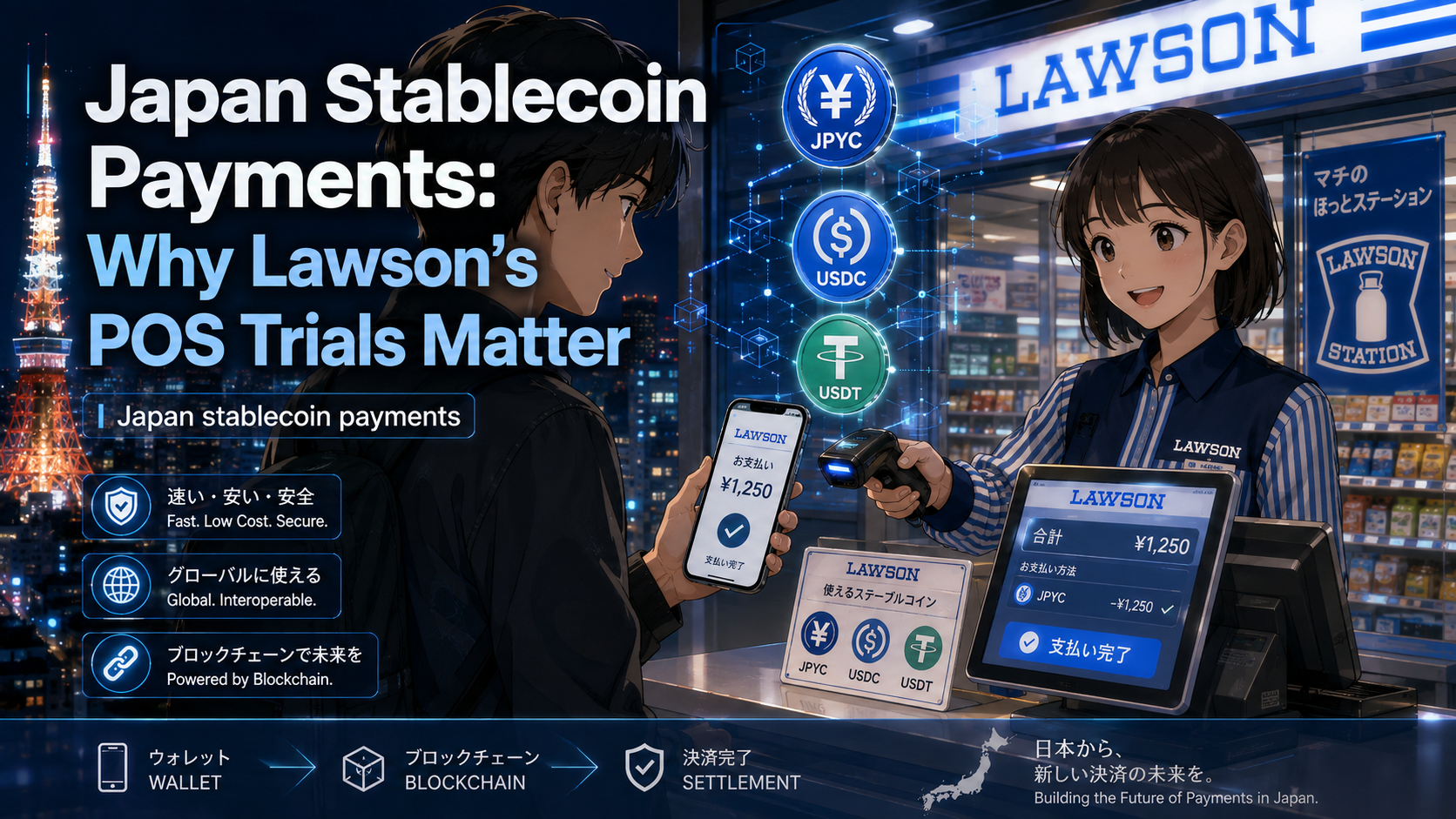
Japan Stablecoin Payments: Why Lawson’s POS Trials Matter
Japan stablecoin payments are moving closer to everyday retail infrastructure. In August 2026, Lawson conducted a series of proof-of-concept trials that connected stablecoins directly with the convenience-store chain’s existing POS registers.
The important development is not simply that stablecoins were used to buy products. The bigger shift is that retailers are testing how blockchain-based money can fit into checkout systems that already exist.
On August 6, Lawson tested the yen-denominated JPYC. On August 17, a second trial with NETSTARS tested JPYC alongside the dollar-denominated USDC and USDT across multiple blockchain networks. Lawson described the initiative as Japan’s first trial of in-store stablecoin payments directly through a POS register. The tests were limited to participating personnel and were not a public commercial rollout.
Contents
- What Lawson Tested with Stablecoin Payments
- Why POS Integration Matters More Than the Coin
- Why USDC, USDT and JPYC Together Matter
- What Japan Stablecoin Payments Mean for Retailers
- How Renesis Tech Japan Supports Stablecoin Payment Infrastructure
This development also connects with our earlier analysis of JPYC and Japan’s digital economy, foreign stablecoins entering Japan, and the wider movement toward on-chain finance in Japan.
What Lawson Tested with Stablecoin Payments
Lawson’s August experiments tested two slightly different models.
The August 6 trial at Lawson Takanawa Gateway City used JPYC through HashPort Wallet.
The August 17 experiment at Lawson Gate City Osaki Atrium Store went further. NETSTARS connected its Stablecoin Pay infrastructure to the store POS and tested:
- USDC on Solana, Morph and Polygon
- USDT on Solana, Morph and Polygon
- JPYC on Polygon
- MetaMask as the participating wallet
The experiment examined payment speed, usability, store operations, POS integration and how the system behaved across different payment and error scenarios. NETSTARS later said the trial confirmed the practical applicability of multi-coin, multi-chain stablecoin payments in a real convenience-store environment.
This is a much more practical test than simply transferring a stablecoin between two wallets.
A retail payment has to work while a customer is standing at the register, without creating significant additional work for store staff.
Why POS Integration Matters More Than the Coin
The most significant part of Lawson’s experiment may be the POS register itself.
Until now, using stablecoins at physical retailers has often required a separate terminal, manually displayed QR code or a payment flow disconnected from the retailer’s normal checkout system.
Lawson instead tested a flow where the customer displays a barcode from a wallet application and the store scans it through its existing POS environment. Payment information is then exchanged between the POS, payment gateway and wallet infrastructure.
This means the retailer does not necessarily need to rebuild the checkout experience around blockchain.
That distinction is critical for adoption.
Large retailers already operate complex systems covering product information, taxes, inventory, promotions, payments, accounting and settlement. A new payment method becomes much easier to consider when it can be added to that environment rather than replacing it.
Lawson specifically tested POS connectivity, settlement operations and payment completion times as part of the trials.
In other words, the question is starting to change from:
“Can someone pay with a stablecoin?”
to:
“Can stablecoins operate reliably inside existing retail payment infrastructure?”
Why USDC, USDT and JPYC Together Matter
The August 17 experiment is also notable because it did not focus on a single stablecoin or blockchain.
JPYC represents a yen-denominated payment option designed for the Japanese market.
USDC and USDT introduce something different: access to dollar-denominated digital value already used internationally.
Testing them together creates a possible future model where payment infrastructure can support both domestic digital currencies and global stablecoins through the same merchant environment.
For Japan, one particularly interesting use case is inbound tourism.
A visitor holding USDC may eventually be able to pay directly from a compatible wallet rather than first converting funds into yen or loading another local payment service.
NETSTARS explicitly identified international travelers as one potential use case arising from the Lawson test.
A separate initiative announced by Digital Garage, JCB and Lawson reinforces this direction. Their Lawson PoC, scheduled for August 20, focused specifically on visitors using USDC on Base, with the store POS scanning a barcode generated from the user’s wallet. Under the proposed model, JCB receives the stablecoin and later settles the merchant’s proceeds in fiat currency.
That last part matters enormously.
Retailers may gain access to blockchain-based payments without necessarily wanting stablecoins sitting on their own balance sheets.
What Japan Stablecoin Payments Mean for Retailers
For merchants, accepting stablecoins is not simply a matter of adding a wallet address.
A production system may need to handle:
- POS and payment-gateway integration
- Supported coins and blockchain networks
- Wallet compatibility
- Transaction confirmation and error handling
- Stablecoin-to-fiat merchant settlement
- Refunds and reconciliation
- Accounting and transaction records
- Compliance and risk controls
The customer experience must also remain simple.
A shopper does not want to think about blockchain networks, gas fees, bridges or settlement architecture while standing at a convenience-store counter.
The successful payment experience should feel almost as ordinary as scanning an existing QR payment code.
This is why the Lawson trials are strategically interesting.
The blockchain is gradually disappearing behind the payment experience.
That is often what happens when a technology begins moving from experimentation toward infrastructure.
How Renesis Tech Japan Supports Stablecoin Payment Infrastructure
For companies exploring stablecoin payments, the technical challenge increasingly sits between blockchain infrastructure and existing business systems.
Renesis Tech Japan supports companies in building this integration layer, including stablecoin payment systems, wallet integrations, payment APIs, merchant dashboards, transaction monitoring, settlement workflows and blockchain connectivity.
For retailers and payment providers, this can include connecting wallet-based payments with existing POS, accounting, CRM or back-office environments.
For international use cases, systems may also need to manage multiple currencies, multiple blockchain networks and different settlement routes while keeping the customer-facing experience simple.
The objective should not be to add blockchain for its own sake.
It should be to make digital money work inside the systems businesses already depend on.
Lawson’s recent experiments suggest that Japan stablecoin payments are beginning to move in exactly that direction: from standalone Web3 experiences toward integrated payment infrastructure.
And if that transition continues, the convenience-store checkout may become one of the places where blockchain finally becomes invisible enough to matter.