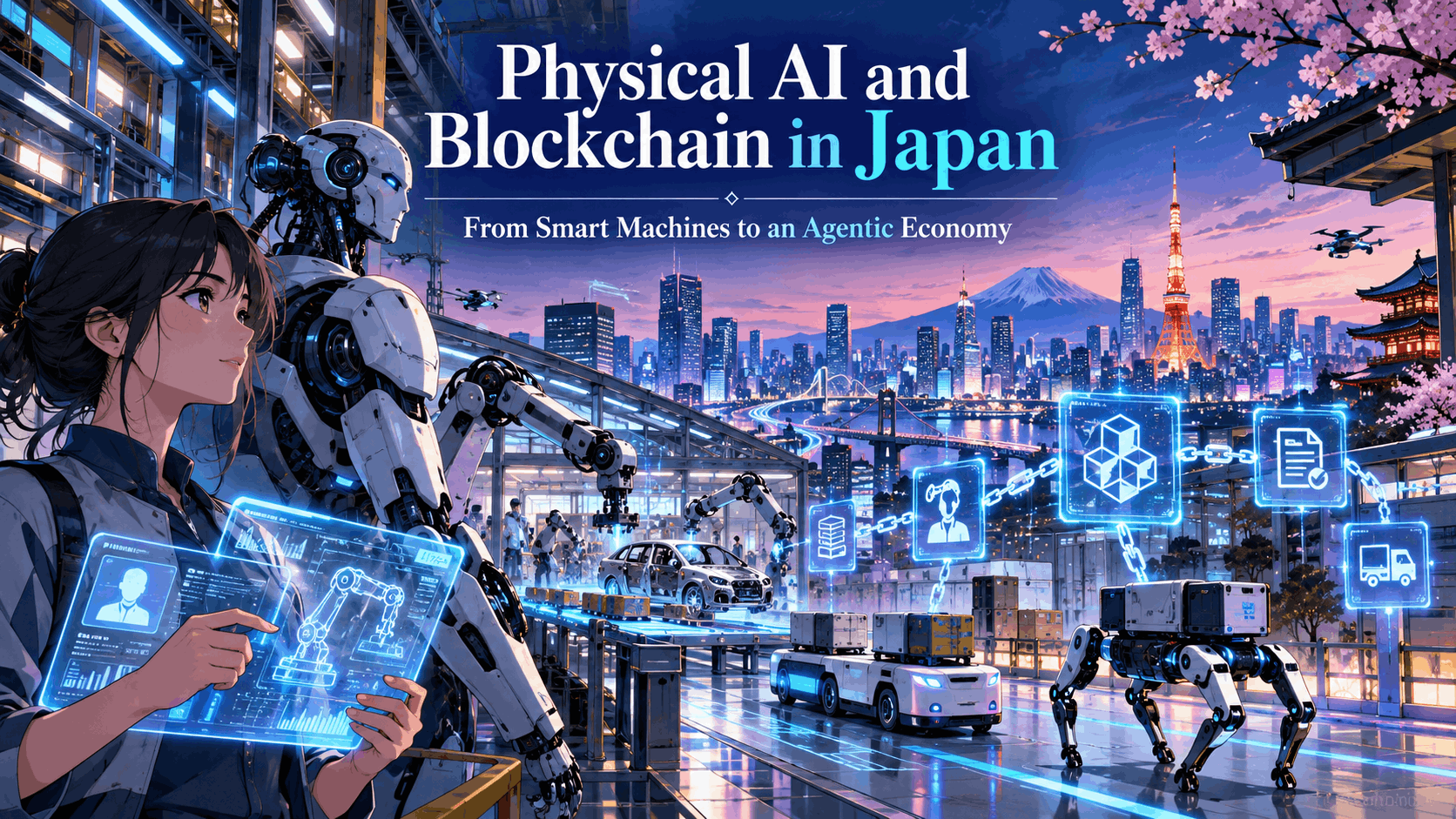
Physical AI and Blockchain in Japan
Physical AI and Blockchain in Japan
Physical AI and blockchain in Japan are advancing on two parallel tracks that could eventually reshape how machines, AI agents, assets, and enterprise systems interact.
On one side, AI is moving beyond chatbots and software into robots, factories, vehicles, sensors, and other physical environments. On the other, blockchain is progressing beyond crypto trading toward programmable payments, tokenized assets, settlement, digital identity, and verifiable records.
These technologies are not yet operating as one mature ecosystem. However, developments involving Noetra, the Bank of Japan, Japan’s Financial Services Agency, MUFG-related organizations, and Japanese Web3 companies suggest that many of the building blocks required for convergence are beginning to emerge.
The bigger question is becoming:
What happens when AI systems that can understand and act in the physical world also gain access to infrastructure that allows them to verify, transact, authorize, and settle autonomously?
Contents
- How Physical AI and Blockchain in Japan Are Advancing
- Blockchain Infrastructure for Physical AI and AI Agents
- How AI Agents Are Connecting Physical AI and Blockchain
- How Physical AI and Blockchain in Japan Could Converge
- Building a Trusted Machine Economy in Japan
- Why Physical AI and Blockchain in Japan Matter for Enterprises
- How Renesis Tech Japan Can Support Physical AI and Blockchain Adoption
How Physical AI and Blockchain in Japan Are Advancing
Japan has long held strengths in robotics, manufacturing, sensors, industrial equipment, and automation.
Physical AI adds another layer to those capabilities.
Instead of AI working mainly with text and digital information, Physical AI is designed to understand information from the real world and eventually help machines make decisions within physical environments.
A major development came in July 2026.
Noetra, backed by core companies including Sony Group, SoftBank, NEC, and Honda, began full-scale development of a Japan-developed multimodal foundation model intended to support AI-enabled robots and Physical AI.
The initiative involves dozens of Japanese companies and organizations, alongside participants such as AIST and Preferred Networks.
The significance is not simply that Japan is developing another AI model.
A multimodal system designed around physical environments could process combinations of video, images, sensor information, language, and operational data.
That creates potential applications across:
- manufacturing
- logistics
- mobility
- equipment inspection
- predictive maintenance
- construction
- industrial automation
The shift is therefore from AI that primarily understands information toward AI that can increasingly understand operations and physical conditions.
At the same time, Japan is also developing blockchain-based financial and transaction infrastructure.
The two fields are still largely separate today, but their advancement is increasingly relevant to the same question: how autonomous systems can operate securely, transparently, and under clear rules.
Blockchain Infrastructure for Physical AI and AI Agents
Japan’s blockchain ecosystem is becoming increasingly institutional.
At FIN/SUM 2026, Bank of Japan Governor Kazuo Ueda discussed a financial ecosystem increasingly shaped by both AI and blockchain.
Potential applications included AI agents using transaction and settlement information, automated collateral management, and AI-supported AML/CFT processes.
The underlying blockchain infrastructure is also developing.
Japan’s Financial Services Agency has supported payment innovation initiatives involving assets such as:
- government bonds
- corporate bonds
- investment trusts
- equities
- stablecoin-based settlement
In these models, blockchain can record or transfer rights while programmable payment infrastructure handles settlement.
That changes the role of blockchain.
It becomes less about speculation around digital assets and more about programmable transaction infrastructure.
Smart contracts can define:
- who can perform an action
- what conditions must be satisfied
- what asset can be transferred
- how settlement should occur
- what records must be retained
This becomes particularly relevant when AI systems begin making decisions with less direct human involvement.
The more autonomous a system becomes, the more important questions of authorization, identity, accountability, and auditability become.
How AI Agents Are Connecting Physical AI and Blockchain
Early signs of AI and blockchain convergence are already appearing in Japan.
In April 2026, MUFG Innovation Partners discussed a model involving tokenized securities, stablecoins, and autonomous AI agents.
In such an environment, assets could exist on blockchain infrastructure, payments could settle using stablecoins, and AI agents could eventually interact with those financial rails autonomously.
Another development came from Tokyo-based Pacific Meta.
In May, the company acquired Komlock lab to strengthen its capabilities across blockchain and AI agents.
Its stated direction includes infrastructure that could allow AI agents to execute contracts, payments, and value exchange using technologies such as:
- wallets
- smart contracts
- stablecoins
- blockchain infrastructure
These developments are primarily focused on digital and financial AI agents today rather than autonomous factory robots.
That distinction matters.
Japan does not yet have a mature economy where industrial machines routinely purchase components or execute blockchain transactions independently.
What is emerging instead is a collection of technological layers that could eventually work together.
Physical AI provides perception and reasoning.
Robotics and IoT provide interaction with the physical world.
Blockchain provides identity, provenance, permissions, and programmable rules.
Stablecoins and tokenized money provide settlement.
AI agents connect decisions with transactions.
How Physical AI and Blockchain in Japan Could Converge
The long-term significance of Physical AI and blockchain in Japan becomes clearer when these layers are viewed as part of one enterprise workflow.
Imagine an industrial machine equipped with sensors and AI.
The system detects that unusual vibration patterns suggest a component may fail within several days.
Physical AI interprets the sensor information and identifies the likely fault.
An AI agent checks the approved maintenance policy and available replacement parts.
Digital credentials verify whether the supplier and component meet company requirements.
The enterprise system confirms that the transaction falls within predefined purchasing limits.
A smart contract can enforce those conditions.
A programmable payment system could then complete settlement.
Once maintenance is performed, the event can be recorded together with information about:
- the machine
- the component
- the supplier
- the authorization
- the maintenance action
- the transaction
The employee using the system does not need to think about blockchain.
It simply operates underneath the workflow as part of the trust, verification, and transaction infrastructure.
This complete scenario should still be viewed as forward-looking rather than a description of a widely deployed Japanese production environment today.
However, many of the individual components required to create such systems are already being developed.
Building a Trusted Machine Economy in Japan
The potential convergence is not limited to automated purchasing.
Physical AI combined with trusted digital infrastructure could support several new operational models.
Machine Identity
Individual robots, devices, vehicles, and sensors could have verifiable digital identities.
This could make it easier for enterprise systems to confirm which machine generated a record, requested a service, or performed a particular action.
Data Provenance
Companies could verify where important operational data originated and whether it was changed.
This becomes particularly useful when multiple organizations depend on the same information.
Automated Inspections
AI could identify quality or safety issues while important inspection records are preserved for verification and audit.
Supply-Chain Traceability
Physical goods could be connected with trusted digital records covering production, transport, ownership, certification, or maintenance.
Machine-to-Machine Transactions
Autonomous systems could eventually purchase energy, computing resources, replacement components, logistics capacity, or other services within predefined spending and approval limits.
Cross-Company Operational Records
Multiple organizations could share trusted information without relying entirely on one company’s internal database.
This is where blockchain can become relevant to Physical AI without being forced into every workflow.
If only one company needs the information and already controls the database, blockchain may add little value.
Its stronger use case appears when multiple organizations need to trust the same transaction, identity, asset, or operational record.
Why Physical AI and Blockchain in Japan Matter for Enterprises
Physical AI and blockchain in Japan should not be viewed only through the lens of humanoid robots or major financial institutions.
A company can begin with a much smaller operational problem.
A manufacturer could use:
Camera → AI inspection → verified quality record
A logistics company could use:
IoT sensor → AI anomaly detection → trusted shipment history
A construction company could use:
Site camera → AI safety inspection → verifiable compliance record
An equipment-maintenance business could use:
Sensor data → predictive AI → maintenance approval → service history
A supply-chain business could use:
Product data → AI validation → digital provenance
Across these examples, the underlying workflow follows a similar pattern:
Observe → Understand → Decide → Authorize → Act → Record
AI can increasingly support observation, understanding, and decision-making.
Enterprise systems manage authorization and execution.
Blockchain becomes useful where the resulting transaction or record needs to remain verifiable across different organizations or systems.
That is where the combination can move from technological experimentation toward practical business infrastructure.
How Renesis Tech Japan Can Support Physical AI and Blockchain Adoption
For enterprises, the real challenge is unlikely to be choosing between AI and blockchain.
The challenge is connecting these technologies to the systems, equipment, data, and workflows already running the business.
Renesis Tech Japan can support this integration across several layers.
AI and Intelligence
- AI agents
- computer vision
- multimodal AI
- predictive models
- enterprise knowledge systems
Physical and Operational Systems
- IoT
- sensors
- cameras
- device integrations
- industrial APIs
- operational dashboards
Blockchain Infrastructure
- smart contracts
- digital identity
- provenance
- verifiable records
- tokenization
- programmable settlement
Enterprise Integration
- ERP
- CRM
- databases
- approval workflows
- dashboards
- payment systems
The starting point does not need to be a fully autonomous factory.
It could be one inspection process, one maintenance workflow, one logistics route, or one data-sharing problem.
A more practical first question is:
“Which operational decision would benefit from more intelligence, and which part of that process requires stronger trust or verification?”
That provides a clearer path from PoC to production.
Japan’s Physical AI initiatives are giving machines better ways to understand and interact with the physical world.
Its blockchain and digital-finance initiatives are creating increasingly programmable infrastructure for transactions, ownership, identity, and settlement.
AI agents are beginning to connect these environments.
Physical AI and blockchain in Japan have not fully merged into a single industrial ecosystem yet.
But the individual technologies required for that convergence are increasingly being built.
The next major shift may therefore not be an employee asking an AI assistant what to do.
It may be an intelligent system observing what is happening, making a decision, executing an authorized action, and leaving behind a trusted digital record of what occurred.