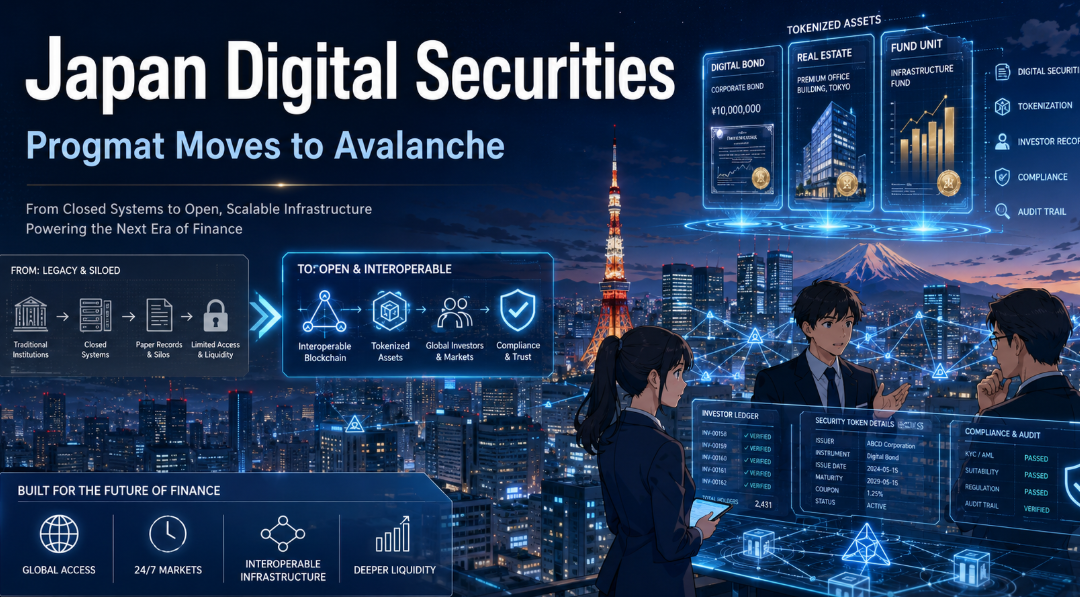
Japan Digital Securities: Progmat Moves to Avalanche
Japan digital securities are entering a new phase in 2026. Progmat has completed the migration of more than ¥452 billion in active security tokens from its previous Corda-based environment to a dedicated Avalanche Layer 1 network. The move shows that Japan’s tokenized-asset market is progressing beyond isolated institutional systems toward infrastructure designed for greater speed, flexibility, and interoperability.
This development connects with Japan’s wider shift toward on-chain finance, our earlier analysis of the Japanese government bond blockchain proof of concept.
What Japan Digital Securities Mean for the Market
Digital securities represent traditional financial assets issued and managed through blockchain infrastructure. They can include tokenized real estate, corporate bonds, investment funds, and other regulated products.
Progmat is particularly important because it is not a small experimental platform. It supports a substantial share of Japan’s active security-token market, including real estate security tokens and tokenized corporate bonds.
The migration should therefore not be viewed only as a technical blockchain update. It affects infrastructure already used by financial institutions and existing regulated products.
Until now, much of Japan’s security-token activity has operated within permissioned systems designed primarily for domestic institutions. These environments provide control and regulatory certainty, but they can be difficult to connect with new wallets, applications, settlement networks, and international tokenization platforms.
Progmat’s new architecture attempts to preserve institutional controls while creating more room for future connectivity.
Why Progmat’s Avalanche Migration Matters
The migration moved Progmat’s active digital securities onto a dedicated Avalanche L1 rather than placing them directly on an unrestricted public network.
This distinction matters. Financial institutions still require permission controls, approved validators, identity management, transaction records, and compliance rules. The goal is not to remove those controls, but to place them on infrastructure that can support broader technical development.
The new environment introduces several practical changes:
- EVM compatibility for digital-securities applications
- Faster processing of ownership-right transfers
- A blockchain-independent architecture that can support future multi-chain use
- Continued institutional governance and permission controls
- More potential connectivity with external blockchain applications
Progmat has also stated that the migration was completed without operational disruption to participating financial institutions.
This is important because regulated financial infrastructure cannot be treated like an ordinary software experiment. Existing products, investors, records, and institutional workflows must continue functioning while the underlying technology changes.
Why Japan Digital Securities Matter for Enterprises
For enterprises, the opportunity is not simply to issue a token. A functioning digital-securities product requires an entire operational layer around the blockchain.
A company considering tokenized real estate, bonds, investment products, or other assets may need:
- Investor onboarding and identity verification
- Wallet and permission management
- Automated compliance and transfer restrictions
- Ownership and transaction records
- Integration with custody, accounting, and settlement systems
For example, a property company could use digital securities to divide an asset into smaller regulated investment units. A financial institution could automate parts of issuance, ownership transfer, and reporting. An asset manager could provide investors with a digital portal showing holdings, distributions, and transaction history.
However, these benefits depend on the quality of the surrounding infrastructure. Smart contracts alone are not enough. Companies need governance rules, legal documentation, security controls, investor communication, accounting treatment, and reliable links with existing enterprise systems.
The real question is not:
“Can this asset be tokenized?”
The more important question is:
“Can the tokenized asset be issued, managed, audited, and transferred safely at institutional scale?”
How Progmat Could Change Japan’s Tokenization Market
Progmat’s migration suggests that Japan’s digital-securities market is moving from individual proofs of concept toward reusable financial infrastructure.
Japan has already developed activity around tokenized real estate and corporate bonds. A more flexible platform could eventually support wider asset categories, new investor applications, improved settlement models, and stronger connections with other on-chain financial systems.
This does not mean Japan’s security-token market has suddenly become fully open or globally interoperable. Regulatory controls, investor eligibility, custody, and financial-market rules will remain central.
What has changed is the technical foundation. Progmat is no longer permanently tied to one ledger architecture. That may make it easier to add new services and connect regulated assets with other approved blockchain environments over time.
Japan digital securities are therefore becoming more than a new format for existing assets. They are becoming an infrastructure question for financial institutions, property companies, asset managers, and enterprise technology providers.
How Renesis Tech Japan Supports Digital Securities Infrastructure
Renesis Tech Japan helps companies build the application and operational layers required to make digital securities commercially useful.
Our work includes tokenization-platform development, smart contracts, investor portals, wallet architecture, compliance dashboards, identity integration, ownership records, and audit-ready transaction systems.
For regulated assets, technical development must also connect with real enterprise workflows. This includes internal approvals, investor onboarding, reporting, accounting, custody integration, and secure access controls.
Renesis Tech Japan supports the full development cycle, from feasibility assessment and PoC design to production systems and integration with existing financial or enterprise infrastructure.
Progmat’s Avalanche migration is not simply a blockchain-platform change. It is a sign that Japan’s digital-securities market is preparing for larger-scale, more connected, and more operationally mature use.
The next step is building the applications and business workflows that turn this infrastructure into practical financial products.