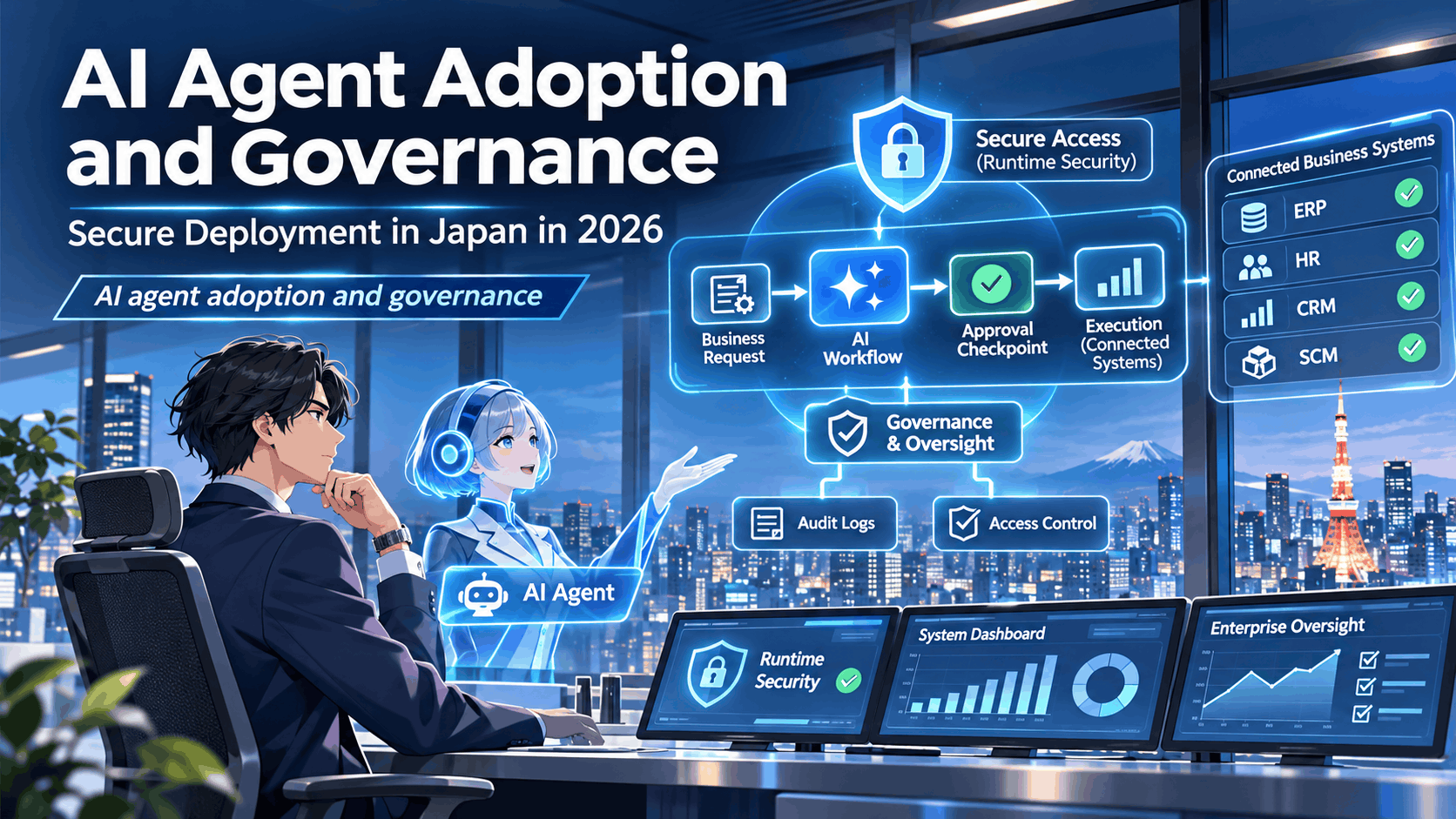
AI Agent Governance in Japan: Balancing Adoption and Control
Key takeaway: Successfully balancing AI agent adoption and governance requires organizations to establish execution permissions, human approval processes, runtime monitoring, activity logs, and emergency shutdown mechanisms before automating business operations. An AI system’s ability to generate accurate responses does not necessarily mean it can safely execute actions within enterprise systems.
In 2026, research into AI agent adoption in Japan revealed a growing gap between implementation and governance maturity. At the same time, new security products have emerged to monitor and control AI agents while they operate. For corporate IT departments, the objective should not be to stop AI adoption, but to establish AI agent governance mechanisms aligned with existing systems, business responsibilities, and operational constraints.
Does Japan Really Lead the World in AI Agent Adoption?
According to an international survey published by KnowBe4 in July 2026, 79% of surveyed Japanese security leaders reported that their organizations had adopted AI agents. This was the highest adoption rate among the 13 countries and regions surveyed. However, the finding does not represent the adoption rate across all Japanese companies.
According to KnowBe4’s official research announcement, the main findings were:
- AI agent adoption: Japan 79%, compared with a global average of 58%.
- Autonomous operation with limited human oversight: Japan 34%, compared with a global average of 17%.
- Limited or unclear AI governance: Japan 40%, compared with a global average of 37%.
- Employees who strongly feel comfortable reporting mistakes: Japan 21%, compared with a global average of 43%.
KnowBe4 reported these figures in its July 10, 2026 announcement. ITmedia’s November 6, 2026 coverage of KnowBe4’s November 4 briefing also referenced the global average of 17% for limited human oversight.
How Should Businesses Interpret These Findings?
The research surveyed 800 security leaders and 3,200 general employees across 13 countries and regions.
The Japanese sample consisted of 75 security leaders and 300 general employees working at organizations with at least 250 employees.
Therefore, describing the results as evidence that “79% of Japanese companies have adopted AI agents” would be misleading.
Similarly, the 34% figure refers to limited human oversight among organizations reporting AI agent adoption. It does not mean that 34% of all Japanese companies operate AI agents without supervision.
Nevertheless, the findings have important implications for enterprise AI strategy and AI agent governance.
Organizations need to consider more than whether AI agents are being adopted.
Is it possible to monitor their activities?
Can employees report problems without hesitation?
Can administrators intervene when unexpected behavior occurs?
Organizations should consider these questions together.
One particularly important finding is the gap between technology adoption and employees’ willingness to report mistakes.
If an AI agent performs an incorrect operation and employees hesitate to report it, technical monitoring alone may not reveal the full extent of the problem.
Organizations should not measure AI adoption maturity solely by the number of users or active agents.
It should also reflect an organization’s ability to understand, supervise, and control their behavior.
Why Do AI Agents Require Different Security Measures?
AI agents can do more than generate text. They can invoke external tools, access enterprise applications, and update business records. As a result, organizations must address not only inaccurate responses but also excessive permissions, unintended operations, and unauthorized access to confidential information.
Traditional generative AI chat applications generally involve a human reviewing the response before taking action.
Business-oriented AI agents, by contrast, may connect directly to company systems and execute a sequence of operations.
Consider an AI agent designed to support a sales department.
It reads customer inquiries, searches internal documentation, and records activity in a CRM.
When properly designed, such a system can reduce administrative work and improve information retrieval.
However, it also introduces potential risks:
- The agent accesses customer records outside the requesting user’s permissions.
- Malicious instructions embedded in an external email are treated as legitimate business commands.
- Incorrect information is written into the CRM, affecting subsequent sales decisions.
- The agent connects to an unauthorized external tool during a workflow.
- When a problem occurs, administrators cannot determine which permissions or credentials were used.
These are hypothetical examples, not incidents attributed to a particular company.
Three Areas AI Agent Governance Must Control
1. Access to Data
Companies should limit AI agent permissions to what the assigned task requires.
Companies should avoid architectures in which a shared administrator account allows agents to bypass existing access controls in ERP systems, CRM platforms, SharePoint, or other business applications.
2. Execution of Actions
Summarizing a document and sending a customer email require different levels of oversight.
The same applies to updating important records, deleting information, or performing actions with financial consequences.
For high-impact operations, companies should introduce appropriate human approval or additional verification.
3. Verification After Execution
Organizations need to understand what an agent received as input, which tools it called, and what actions it performed.
Execution logs are useful not only for troubleshooting but also for reviewing permissions, investigating incidents, and improving operational processes.
These principles are consistent with the risks addressed in the OWASP Top 10 for Agentic Applications 2026.
Building effective generative AI governance requires assessing not only the model itself but also the systems it can access and the actions it is authorized to perform.
What Does Sysdig AI Defense Monitor and Control?
On November 4, 2026, Sysdig announced the general availability of Sysdig AI Defense, a runtime security product designed for AI agents. The solution evaluates actions against organizational policies and can permit, require approval for, or block specific operations during execution.
Runtime security refers to the monitoring and control of software behavior while an application is actively operating.
For AI agents, this means examining what they actually do when interacting with tools, data, operating systems, and cloud infrastructure.
This differs from security testing performed during development.
An agent may pass all predefined tests but encounter different user inputs, permissions, integrations, and operating conditions after deployment.
Continuous monitoring is therefore necessary.
According to Sysdig’s official announcement, Sysdig AI Defense evaluates information including:
- What an agent is attempting to execute.
- What the agent is actually executing within the system.
- Which resources are accessible through the credentials being used.
Why an Agent’s Own Logs Are Not Enough
An AI agent’s application logs may describe its intended actions and tool calls.
However, those logs do not necessarily provide a complete picture of what occurred within the operating system or cloud environment.
Sysdig describes an approach that correlates information from within the agent with execution-level information gathered from the underlying system, including the operating system kernel.
The company also describes capabilities for monitoring MCP servers, skills, and plugin interactions, as well as preventing unauthorized connections and high-risk operations.
Potential applications include:
- Identifying active AI agents and their responsible owners.
- Detecting unauthorized tools and external connections.
- Blocking high-risk operations or requiring human confirmation.
- Recording execution histories and approval decisions.
- Monitoring AI usage costs at the individual agent level.
These are capabilities described by Sysdig.
Readers should not interpret them as guarantees that the product will provide identical monitoring coverage or protection across every enterprise environment.
Before adopting a runtime security product, organizations should verify compatibility with their operating systems, existing security tools, agent execution environments, performance requirements, and logging policies.
Furthermore, deploying a product such as Sysdig AI Defense does not automatically establish complete AI agent governance.
Runtime protection must operate alongside access controls, development-stage testing, approval procedures, data governance, and employee training.
Three AI Agent Governance Mistakes Japanese Companies Should Avoid
Three important mistakes can undermine enterprise AI agent deployment: treating a successful proof of concept as proof of production readiness, giving AI agents unnecessarily broad system permissions, and expanding automation without clearly assigning operational responsibility.
Mistake 1: Connecting a Successful PoC Directly to Production
A proof of concept aims to validate technical feasibility or potential business value.
During testing, an AI agent may interact with a limited dataset and a small number of permitted actions.
However, production environments introduce more users, larger datasets, additional integrations, and more complex combinations of inputs.
Therefore, completing a PoC should not automatically authorize production deployment.
Organizations need a separate security and operational assessment.
Important tests include:
- How the agent responds when asked to access information outside its permissions.
- How it handles malicious instructions embedded in external documents or emails.
- How it responds to API failures, timeouts, and duplicate execution.
- Whether operations requiring human approval are reliably identified and controlled.
Successful functional testing and approval for production operation are different decisions.
Mistake 2: Giving AI Agents Broad Legacy-System Permissions
Legacy applications may rely on older authentication mechanisms or accounts with extensive access rights.
When connecting AI agents under time pressure, developers may be tempted to reuse existing administrator credentials.
However, this creates governance and security concerns.
A more appropriate approach is to issue dedicated credentials for AI agents and distinguish between read-only access, data modification, routine operations, and administrative privileges.
Restrict access according to the task.
Permissions should also be revocable when no longer required.
Where a legacy system cannot support modern authorization controls, organizations may consider introducing an intermediate API layer that exposes only approved functions.
This can provide a more controlled integration point without requiring the agent to interact directly with the entire underlying application.
Mistake 3: Unclear Responsibilities and Incident Reporting
Enterprise AI projects frequently involve several stakeholders, including external developers, internal IT teams, business departments, and security personnel.
Organizations should define their responsibilities before deployment.
Consider an AI agent that updates a business record incorrectly.
The business department needs to evaluate the operational impact.
The IT team may need to stop the process and investigate execution logs.
The development team must identify the technical cause, implement corrective changes, and verify the result.
As the GMO cyberattack showed, unclear ownership can let serious warnings go unaddressed. Clear responsibilities can reduce delays when such problems occur.
KnowBe4’s finding that only 21% of Japanese employee respondents strongly felt comfortable reporting mistakes is also relevant.
Organizations need more than monitoring tools.
They need an environment in which employees can report unexpected AI behavior promptly and without unnecessary hesitation.
How Should Enterprises Select an AI Agent Development Partner?
When choosing an AI agent development company, businesses should evaluate more than model performance and demonstrations. They should examine integration capabilities, access controls, auditability, incident response, and post-deployment maintenance. Buyers should also assess initial development and recurring operating costs separately.
For IT departments already managing legacy systems and limited resources, starting with a narrowly defined workflow is often more practical than attempting broad automation immediately.
For example, an organization could begin with internal document search and summarization.
After validating access controls and operational procedures, it might expand the system to record CRM activities or update selected enterprise applications.
Starting with non-destructive, read-only operations can help limit the impact of early implementation problems.
Five Criteria for Evaluating an AI Development Vendor
1. Requirements Definition and Business Understanding
Can the vendor clearly identify the tasks to automate, excluded operations, and expected exception-handling procedures?
2. Access Control and Data Governance
Can the vendor design user-specific permissions, confidential-data controls, and appropriate logging practices?
3. Integration with Existing Systems
Can the vendor evaluate different ways to connect ERP platforms, CRM applications, internal databases, and legacy software?
4. Testing and Security Measures
Does the implementation plan include testing for incorrect outputs, unauthorized actions, prompt injection, API failures, and abnormal operating conditions?
5. Operational Transparency and Cost Management
Can the vendor explain model usage fees, cloud infrastructure costs, monitoring requirements, maintenance obligations, and responsibility for incident response?
The fifth criterion is especially important because the initial quotation rarely represents the full cost of operating an enterprise AI agent.
Costs depend on factors such as:
- The number of business workflows being automated.
- The number and complexity of connected systems.
- The sensitivity of the information processed.
- The agent’s execution permissions.
- Monitoring and security requirements.
- Ongoing maintenance and support.
Organizations planning production deployment should therefore evaluate recurring expenses alongside the initial engineering investment.
Standards and Frameworks for AI Agent Governance
Several established resources can support enterprise governance planning:
- NIST AI Risk Management Framework: A framework for governing, identifying, measuring, and managing AI risks.
- ISO/IEC 42001:2023: An international standard addressing organizational AI management systems.
- OWASP Top 10 for Agentic Applications 2026: Guidance on security risks and safeguards specific to agentic AI applications.
Adopting a particular software product does not automatically establish compliance with these frameworks or standards.
Organizations must translate the relevant principles into policies, technical controls, and operating procedures appropriate to their environment.
Renesis Tech Japan’s Approach to AI Agent Development
Renesis Tech Japan provides AI Agent Development Services, including solutions built using frameworks such as LangGraph, CrewAI, and AutoGen.
Its Renesis Autonomous Enterprise Framework (RAEF) provides an approach to enterprise AI architecture encompassing system integration, data connectivity, knowledge management, agent coordination, and governance.
However, adopting a development framework does not guarantee security.
Each enterprise deployment still requires appropriate approval workflows, access controls, testing, audit logs, and clearly defined operational responsibilities.
Teams should review these controls continuously after deployment.
Frequently Asked Questions
1. How Much Does AI Agent Development Cost?
Costs depend on the workflows being automated, the number of connected systems, required security controls, and maintenance arrangements.
It would be inappropriate to specify an exact project cost without understanding the requirements. Companies should request separate estimates for initial development and recurring model usage, monitoring, infrastructure, and support.
2. Can AI Agents Be Integrated with Legacy Systems?
Potentially, yes. However, organizations first need to assess the legacy application’s authentication mechanisms, available APIs, and integration constraints.
Where direct integration is impractical or unsafe, a dedicated API layer or intermediate system may allow controlled access to approved functions.
3. What Should Companies Do If They Lack Internal AI Specialists?
The business department and IT team should first define the intended workflow, information requirements, and responsibilities.
Even when development is outsourced, the organization must retain ownership of operational approvals, data governance, and incident-response decisions.
4. Does Runtime Security Software Make AI Agents Safe?
Not by itself.
Products such as Sysdig AI Defense can support monitoring and control during execution, but they do not replace secure system architecture, access controls, development testing, employee training, or business approval procedures.
5. Should Companies Use Multiple AI Agents from the Beginning?
Not necessarily.
If a single agent or conventional workflow automation can achieve the intended outcome, a simpler architecture may be easier to test, supervise, and maintain.
Consider multi-agent systems when distributing responsibilities across agents provides a clear operational advantage.
Conclusion
The discussion around AI agent adoption in Japan in 2026 demonstrates the need to expand AI capabilities and strengthen operational governance at the same time.
KnowBe4’s survey highlights potential gaps between adoption and human oversight.
Sysdig AI Defense represents one technical approach to monitoring and controlling agent behavior during execution.
However, neither research findings nor security products can establish effective AI agent governance automatically.
For corporate IT departments, five practical actions deserve immediate attention.
- Identify active AI agents: Maintain a record of agents, users, responsible owners, and connected systems.
- Review permissions: Confirm which data each agent can access and which operations it can perform.
- Define approval rules: Identify tasks requiring human confirmation, particularly external communications, important data changes, and deletion.
- Establish monitoring and verification: Define logging, anomaly detection, emergency shutdown, and post-remediation testing procedures.
- Review implementation and outsourcing plans: Evaluate vendors based on security architecture, maintenance responsibilities, and cost transparency, not just development capabilities.
The objective of enterprise AI adoption should not be to automate as many tasks as possible. It should be to create measurable business value through systems that organizations can understand, supervise, and control.
Renesis Tech Japan supports businesses exploring AI adoption, workflow automation, and integration with existing enterprise systems.
For companies seeking to identify suitable AI applications and determine where to begin, learn more about the Renesis Tech Japan AI Business Diagnosis.