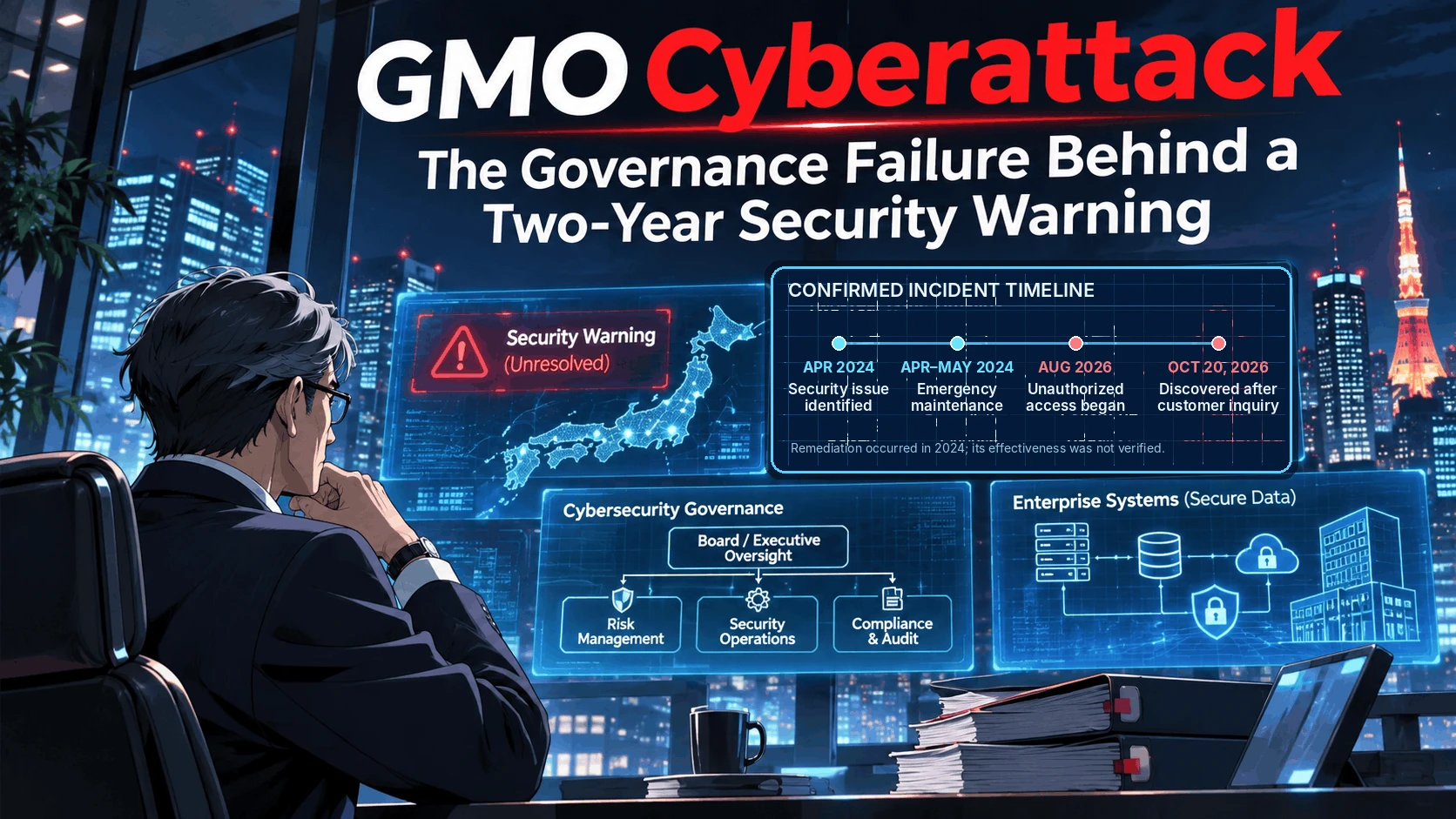
GMO Cyberattack: The Governance Failure Behind a Two-Year Security Warning
The GMO cyberattack has exposed a problem that goes beyond software vulnerabilities: what happens when an organization receives a security warning, takes corrective action, but cannot demonstrate that it has eliminated the underlying risk?
On November 2, 2026, GMO Internet Group Chairman and CEO Masatoshi Kumagai publicly apologized after unauthorized access to the company’s Onamae.com Desktop Cloud service led to customer information exposure and financial losses.
The admission that attracted particular attention concerned an earlier warning.
In April 2024, specialists from group subsidiary GMO Cybersecurity by Ierae had identified security issues involving the service. GMO Internet subsequently carried out four emergency maintenance operations.
However, the company acknowledged that its response had been insufficient.
The warning never reached the group CEO, and internal monitoring did not detect the subsequent cyberattack. Instead, GMO began investigating after receiving a customer inquiry on October 20, 2026.
For Japanese business leaders, the most important question is not simply why an attacker found a way into the system.
It is why an organization with access to cybersecurity specialists struggled to translate their findings into effective, verifiable protection.
The GMO cyberattack raises a fundamental question for enterprise IT governance: who is responsible for proving that the organization has actually resolved an identified security risk?
That question matters to manufacturers, financial services companies, logistics operators, SaaS providers, and smaller businesses alike.
It also deserves particular attention as Japanese companies expand their use of AI, cloud infrastructure, external software vendors, and interconnected enterprise systems.
GMO Cyberattack: What Happened and When?
The incident affected Onamae.com Desktop Cloud, a virtual private server service used by customers for purposes including automated foreign-exchange trading.
According to the chronology presented at GMO’s November 2 press conference, the attacker first accessed a customer’s virtual desktop environment on August 5, 2026.
The attacker subsequently obtained administrator credentials and accessed a management server on August 17.
Between September 20 and October 14, the attacker distributed malicious software into customer VPS environments.
However, GMO did not identify the intrusion through its regular monitoring.
The company began its investigation on October 20 after a customer reported suspicious activity.
On October 21, GMO Internet publicly disclosed the unauthorized access and confirmed that an unauthorized program was present in some customer environments.
Further investigation identified risks involving stored trading-account credentials and unauthorized transactions.
At the November 2 press conference, Kumagai acknowledged that the attack had exposed customer information and that customers had suffered financial harm.
The company also faced an extortion demand of approximately ¥8 billion, which it refused to pay.
GMO announced customer-support and compensation measures, including reimbursement of confirmed losses arising from unauthorized transactions and a ¥5,000 payment to affected service users.
These measures are important, but they address consequences after the event.
They do not explain why the security issues remained unresolved or why the intrusion went undetected for an extended period.
The GMO cyberattack therefore presents two separate governance questions: why preventive controls were insufficient, and why detection and escalation failed once the intrusion occurred.
Understanding both is essential before discussing the implications for other organizations.
The 2024 Warning: A Critical GMO Cyberattack Lesson
One of the most significant disclosures from the press conference concerned events more than two years before the incident.
In April 2024, GMO Cybersecurity by Ierae, a specialist cybersecurity business within the GMO group, identified problems with the service.
GMO Internet responded by conducting four emergency maintenance operations during April and May.
These actions demonstrate that the warning was not entirely ignored.
However, according to the company’s November 2 explanation, the measures were not sufficiently thorough.
Executives said the company had not supported decisions involving stable service operations, development work, and other security priorities with adequate risk analysis.
The company subsequently recognized that it had misjudged whether its measures sufficiently addressed the original issues.
Nikkei XTECH also reported on November 2 that GMO did not follow the corrective measures with a fresh security diagnosis to confirm their effectiveness.
This distinction is central to the case.
Completing maintenance is not the same as proving that a fix has removed a security vulnerability.
Administrative Closure vs. Verified Remediation
In a typical enterprise environment, a vulnerability report may pass through several stages.
A security specialist identifies a weakness.
An engineering team receives the finding.
Management approves a remediation plan.
Developers or infrastructure engineers implement changes.
A project manager or service owner marks the associated work as completed.
Yet one question may remain unanswered.
Did anyone independently verify that the original security weakness was no longer exploitable?
That is the difference between administrative closure and verified remediation.
The distinction matters because organizations often track activities rather than outcomes.
A ticket may show that someone applied a patch or changed a configuration.
Neither fact, by itself, establishes that the affected system has reached an acceptable security state.
The strongest lesson from the GMO cyberattack is therefore not that companies should conduct more security assessments indiscriminately.
It is that critical findings need an accountable path from identification to verification.
An important limitation remains: public reporting has not conclusively established the technical relationship between every issue raised in 2024 and the specific attack path used in August 2026.
Consequently, it would be inaccurate to claim that repeating the earlier assessment would certainly have prevented the attack.
However, the absence of verified closure is a legitimate governance concern regardless of that unresolved causal question.
Why the GMO Cyberattack Exposed an Escalation Problem
A second issue emerged during the press conference.
Kumagai said that the 2024 security concerns had not reached him and that he learned of the warning in connection with the incident.
The group operated at a scale of approximately 150 companies and 8,300 employees, according to his explanation.
Its legal representative also acknowledged that there had not been a clear quantitative standard defining which vulnerabilities required escalation to the board.
Instead, managers made escalation decisions case by case.
This raises a serious organizational question.
What happens when the people who understand a technical risk do not have a reliable mechanism for ensuring that the right decision-makers act on it?
Large organizations often separate business operations, software development, cybersecurity, compliance, and executive management.
Those divisions are necessary for specialization.
However, they can also create gaps in accountability.
A security team may identify a technically serious problem.
The operating business may prioritize service availability.
Engineering managers may believe that a partial mitigation is sufficient.
Senior executives may receive no information because the finding does not meet an established reporting threshold, or because no such threshold exists.
The result is a risk that everyone assumes someone else is managing.
Setting Clear Escalation Thresholds
This does not mean every vulnerability needs direct CEO involvement.
That would be impractical.
Instead, companies need objective criteria that distinguish routine findings from issues requiring senior oversight.
Examples include vulnerabilities affecting privileged access, systems processing sensitive customer information, business-critical services, or controls whose failure could compromise multiple customer environments.
Other escalation triggers might include repeated remediation delays, uncertainty about whether a fix works, or a serious disagreement between the security team and the service owner.
The governing principle is straightforward.
A business unit should not be able to silently accept a potentially critical security risk merely because the consequences of remediation are inconvenient.
An appropriate level of management should approve any decision to defer high-risk work, and the organization should document that decision and set a time limit.
For organizations examining the GMO cyberattack, that is a more useful lesson than debating which executive should have personally read a specific technical report.
The issue is whether the system of responsibility was capable of making the risk visible.
Verified Remediation: The Missing Link in Security Governance
Nikkei XTECH’s November 2 reporting highlighted another concern: GMO did not perform a follow-up security diagnosis after the 2024 maintenance work.
That reported gap points toward a common weakness in enterprise security programs.
Organizations may invest in vulnerability scanning, penetration testing, code reviews, and security audits.
However, the value of those assessments depends on what happens afterward.
Suppose a penetration test identifies a weakness in an administrative interface.
The engineering team implements a change and reports that the problem is fixed.
Should the team immediately mark the issue as resolved?
Not necessarily.
The original weakness may still exist through another endpoint.
Engineers may not have deployed the change consistently across environments.
An overlooked dependency may preserve the attack path.
Alternatively, the fix may address one vulnerability while introducing another.
Independent retesting is therefore important, particularly when a finding affects a critical service or privileged access.
The required evidence will depend on the nature of the issue.
It might include a successful verification test, updated configuration evidence, an approved security review, or confirmation that the original exploit path no longer works.
For the organization, the record should answer three questions.
What was the original risk?
What changed to address it?
And which evidence demonstrates that the response was effective?
An effective process should also identify who has authority to accept any remaining risk.
The GMO cyberattack illustrates why this is an executive concern rather than a purely technical matter.
If a company cannot distinguish between completed remediation work and verified risk reduction, its dashboards may communicate a misleading sense of security.
A long list of closed vulnerabilities can look reassuring.
Yet the number of closed tickets matters far less than whether important risks have genuinely been controlled.
Can AI Prevent the Next GMO Cyberattack?
The incident has also generated discussion about artificial intelligence.
During the press conference, Kumagai warned that AI could accelerate the capabilities of cybercriminals.
Nikkei XTECH separately reported that GMO expanded the application of an internally developed AI-based security diagnosis across its group only after the incident.
These developments raise a relevant question for Japanese enterprises.
Will AI-based security monitoring solve the governance problems exposed by the GMO cyberattack?
The answer is more complicated than simply deploying another scanning tool.
AI can help organizations analyze large volumes of technical information.
Potential applications include prioritizing vulnerability findings, identifying unusual system behavior, summarizing security reports, and correlating issues across different services.
AI-assisted tools may also reduce the manual effort required to review security documentation and prepare operational summaries.
Why Automated Detection Is Not Enough
However, automated detection does not guarantee remediation.
An AI system might identify a serious configuration weakness.
If the finding goes to the wrong team, receives no owner, or keeps slipping without escalation, the organization remains exposed.
Similarly, a team may classify a vulnerability as resolved after an engineering change even though no independent verification has taken place.
AI cannot resolve that accountability problem by itself.
A useful approach combines technological capabilities with defined responsibilities.
Organizations should connect security findings to accountable owners, risk classifications, deadlines, evidence requirements, and escalation procedures.
AI can support those workflows by making information easier to analyze and retrieve.
But authorization to accept a critical risk should remain with an appropriate human decision-maker.
There is also a separate issue of evidence.
The publicly available incident record does not establish that AI enabled the attack, nor does it prove that AI-based scanning would have prevented it.
Readers should therefore distinguish claims about AI-driven cyberattacks from the verified facts of this incident.
For businesses considering AI security tools, the practical question is not merely whether the software can find more vulnerabilities.
It is whether the organization can reliably act on what the software finds.
The lesson from the GMO cyberattack is that organizations must match better detection with better decisions, clearer accountability, and proof of remediation.
Why the GMO Cyberattack Became a Reputation Crisis
Cybersecurity incidents create business risks beyond the technical compromise.
Customers may lose access to services, face financial losses, or become concerned about the safety of their personal information.
For cloud and infrastructure providers, these consequences can affect trust in services that customers depend on for everyday operations.
The Executive Communications Problem
The GMO incident also developed a separate communications problem.
Following the breach, Kumagai faced criticism over social media posts that included smiling photographs and references to people affected by the incident.
At the November 2 press conference, he acknowledged that the posts had lacked appropriate consideration for the feelings of affected customers and apologized.
He explained that he intended some of the communications to demonstrate that the company would not submit to intimidation.
Nevertheless, the public response revealed an important difference between the intention behind a message and how customers experience it.
During a cybersecurity crisis, people want to understand what happened, what information or services may be at risk, what actions they should take, and whether the organization is responding responsibly.
Executive statements can support that process.
However, they can also distract from it.
A company may have strong values and a sincere commitment to customers.
Those commitments are meaningful only when they are accompanied by clear operational action and communication that reflects the immediate concerns of those affected.
The GMO cyberattack demonstrates why organizations should treat incident communication as part of cybersecurity governance.
It is not simply a public-relations task performed after technical teams begin investigating.
An effective communications process should establish who may speak, how the team verifies updates, how it prioritizes affected customers, and when executives should communicate personally.
It should also distinguish confirmed facts from ongoing investigations.
A business that responds quickly but communicates carelessly may create avoidable reputational damage.
Conversely, a company that communicates responsibly but fails to resolve the underlying technical issues cannot rebuild confidence through messaging alone.
Both capabilities are necessary.
Japan’s Cybersecurity Governance Standards Already Address These Risks
The lessons emerging from the GMO cyberattack are not entirely new.
Japan’s Ministry of Economy, Trade and Industry (METI) published Version 3.0 of its Cybersecurity Management Guidelines in March 2023.
The guidelines identify three principles for corporate leadership.
First, executives hold responsibility for driving cybersecurity measures.
Second, leaders should look beyond an individual company to its wider supply chain.
Third, the guidelines emphasize communication with internal and external stakeholders during normal operations and emergencies.
In addition, the framework provides ten important management instructions covering organizational structures, resources, risk assessment, continuous improvement, incident readiness, and communication.
These principles are directly relevant to the organizational issues raised by the GMO case.
NIST CSF 2.0 and the Govern Function
The United States National Institute of Standards and Technology (NIST) takes a similar approach.
Its Cybersecurity Framework 2.0 includes a dedicated Govern function.
This function addresses organizational risk-management strategy, responsibilities, policies, oversight, and the connection between cybersecurity and broader enterprise risk.
The significance is that no organization can manage cybersecurity effectively as a separate technical activity.
Business leaders must understand which risks could affect essential operations, sensitive information, legal obligations, and customer trust.
They do not need to personally perform vulnerability assessments.
However, they do need assurance that teams track, assign, address, and verify critical findings.
For Japanese companies, this creates a practical opportunity.
Instead of viewing compliance documents as annual exercises, organizations can turn their principles into everyday management workflows.
A security assessment should feed into a structured risk register.
Critical findings should automatically reach an appropriate owner.
A remediation plan should have an agreed deadline.
Every completed fix should require suitable evidence.
And unresolved critical risks should remain visible to executives until they are addressed or formally accepted.
The outcome is not perfect security.
No governance system can guarantee that.
The objective is to make important risks harder to overlook and easier to act upon.
GMO Cyberattack Lessons: A Cybersecurity Governance Checklist
The most valuable response to the GMO cyberattack is not to assume that similar failures happen only at large technology groups.
Smaller companies can experience the same accountability gaps, often with fewer security resources.
A manufacturer may depend on an external IT vendor.
Meanwhile, a logistics company may use several cloud applications.
A healthcare service provider may integrate patient-related systems with third-party platforms.
In each situation, risks can move between organizations and responsibilities.
Nine Practical Governance Controls
The following checklist provides a practical starting point for executives, IT managers, and business owners.
- Maintain a central risk register. Record critical findings from internal reviews, external assessments, cloud services, and software vendors in one accountable process.
- Assign a named owner to every significant finding. Each issue should have someone responsible for remediation and someone authorized to approve the outcome.
- Establish escalation thresholds. Define which risks must reach the CISO, executive management, or board, particularly when privileged access or sensitive customer systems are involved.
- Require evidence before closing critical findings. Completed maintenance should not automatically mean that the vulnerability is gone. Use independent retesting or other appropriate verification.
- Set deadlines and document exceptions. Where remediation is delayed, record why, the temporary safeguards, the residual risk, and who approved the decision.
- Test detection and incident-response readiness. Review whether suspicious activity would be noticed, who would receive the alert, and how quickly the organization could investigate and contain the problem.
- Prepare crisis communications before an incident. Establish approval responsibilities, customer-notification procedures, and guidelines for executive social media communication.
- Review third-party and group-company responsibilities. Clarify who must act when a security specialist, supplier, or subsidiary identifies a serious problem.
- Report measurable outcomes to management. Track overdue critical findings, verification status, unresolved exceptions, detection capability, and remediation delays rather than relying only on the total number of completed security tasks.
Adapting the Checklist to Your Organization
Each organization should adapt this checklist to its systems, regulatory obligations, and risk exposure.
For a small company, implementing every measure through a sophisticated governance platform may be unnecessary.
A well-maintained register, clear responsibilities, reliable escalation, and documented verification can provide a practical foundation.
Larger organizations may require integrated tooling, centralized reporting, role-based permissions, and automated workflows across multiple business units.
In either case, the same principle applies.
A security issue should remain open until the organization has sufficient evidence that the risk has been addressed or a properly authorized decision has been made about what remains.
What Japanese Businesses Should Do Next
The GMO cyberattack is an important case study because it highlights the difference between possessing cybersecurity expertise and effectively using that expertise within an organization.
GMO had access to specialists who identified security issues in 2024.
Maintenance work followed.
Yet the company later acknowledged that the response was insufficient and that the warning had not reached its group CEO.
The company’s internal monitoring did not detect the attack itself before a customer inquiry prompted investigation.
These facts point toward weaknesses involving risk assessment, verification, escalation, and detection.
They also illustrate why cybersecurity governance must become part of normal enterprise operations.
For Japanese companies undergoing digital transformation, this is especially relevant.
Businesses are adopting AI applications, expanding cloud infrastructure, connecting legacy systems, and relying on an increasing number of software services.
These developments create opportunities for productivity and innovation.
However, they also make it harder to understand where important systems, identities, data, and responsibilities intersect.
An organization that cannot maintain a reliable view of its existing security risks may struggle to manage the additional complexity introduced by new technologies.
How Renesis Tech Japan Can Help
This is where practical system integration and workflow design can support stronger cybersecurity governance.
At Renesis Tech Japan, our focus includes custom enterprise software, AI-assisted workflows, knowledge management, and integration between business systems.
Within an appropriately defined project, these capabilities can support the operational infrastructure surrounding security management.
For example, a company could develop a centralized workflow that connects vulnerability findings from approved assessment tools with an internal task-management system.
The workflow could assign each finding an owner, classification, deadline, and verification requirement.
A management dashboard could provide visibility into overdue critical issues and unresolved exceptions.
AI-assisted functions could summarize authorized assessment reports, identify potentially duplicated records, or prepare information for human review.
Similarly, integration between existing systems could reduce the risk of security findings being lost between departments.
These capabilities would support the management of cybersecurity work.
Companies should not confuse them with independent penetration testing, specialist forensic investigation, or formal security certification.
Those activities require appropriately qualified cybersecurity professionals and, where necessary, independent assurance.
Combining Security Expertise With Accountable Workflows
The strongest enterprise approach brings the relevant capabilities together.
Security specialists identify and validate technical risks.
Engineering teams implement appropriate changes.
Business owners understand the operational consequences.
Governance workflows make responsibilities and decisions visible.
Independent verification provides evidence that critical issues have been adequately addressed.
Renesis Tech Japan can support the software and integration components of that process, helping organizations turn fragmented security information into more accountable operational workflows.
Learn more about our AI, automation, and enterprise software services at Renesis Tech Japan.
The Questions Every Organization Should Answer
Ultimately, the most important question raised by the GMO cyberattack is not whether every business can afford the latest security technology.
It is whether the organization knows what happens after a serious risk has been discovered.
Who receives the warning?
Who decides what must change?
How will anyone confirm that the change works?
And who hears about it if the risk remains unresolved?
No organization can prevent every cybersecurity incident.
But organizations can build processes that reduce the likelihood of important warnings disappearing between departments.
The objective is not simply to find vulnerabilities faster.
It is to ensure that an identified risk does not disappear from management’s attention before the risk itself has been addressed.
That may be the most enduring governance lesson of the GMO cyberattack.
Editorial note: This article is an independent analysis based on publicly available information as of November 3, 2026. The full forensic investigation and final technical causes have not been publicly established. Assertions about the absence of follow-up diagnosis and post-incident AI diagnosis deployment are attributed to Nikkei XTECH reporting. The proposed governance practices are recommendations, not claims about measures already implemented or omitted by GMO beyond those documented in the cited sources.
Sources and further reading
- GMO Internet: Initial unauthorized-access disclosure, October 21, 2026
- GMO Internet: Incident updates and customer guidance
- ITmedia Business: GMO press conference and organizational issues, November 2, 2026
- ITmedia: Follow-up reporting on accountability and internal organizational relationships, November 3, 2026
- Nikkei XTECH: No follow-up diagnosis after the 2024 warning, November 2, 2026
- TBS News: Timeline of the unauthorized access, November 2, 2026
- METI: Cybersecurity Management Guidelines, Version 3.0
- NIST: Cybersecurity Framework 2.0